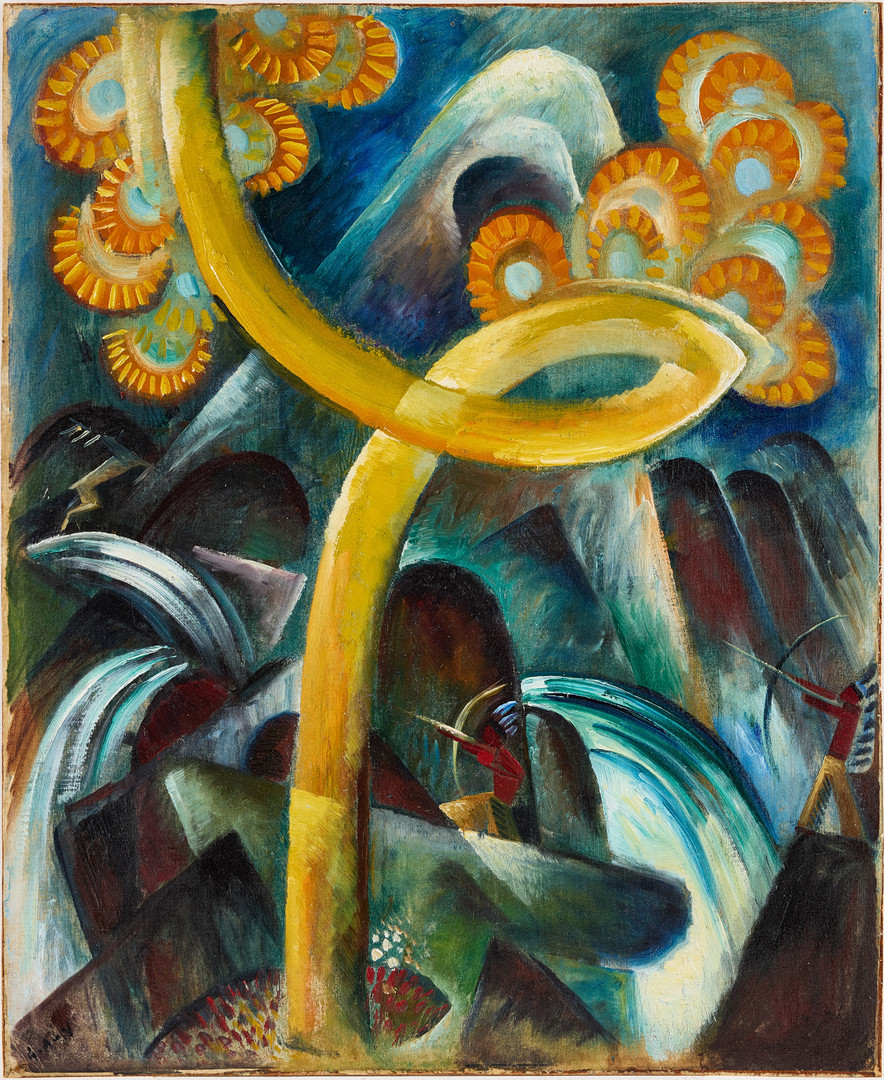
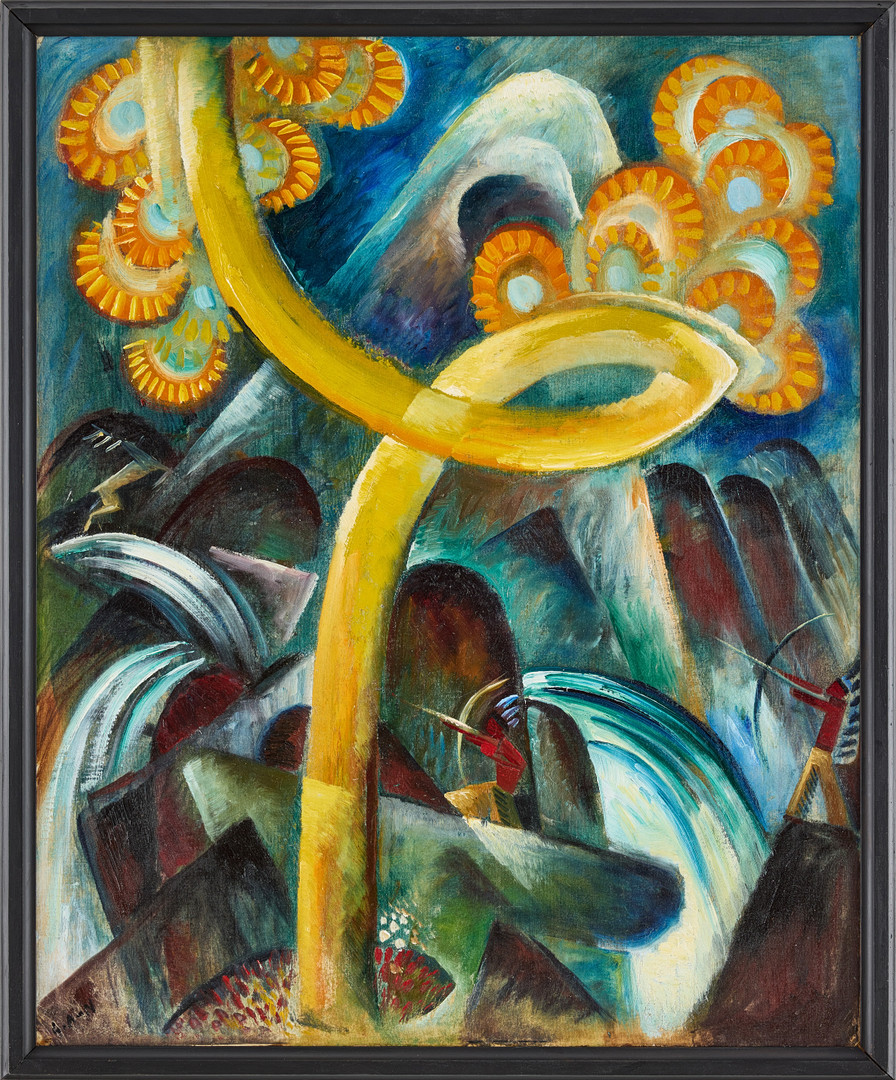
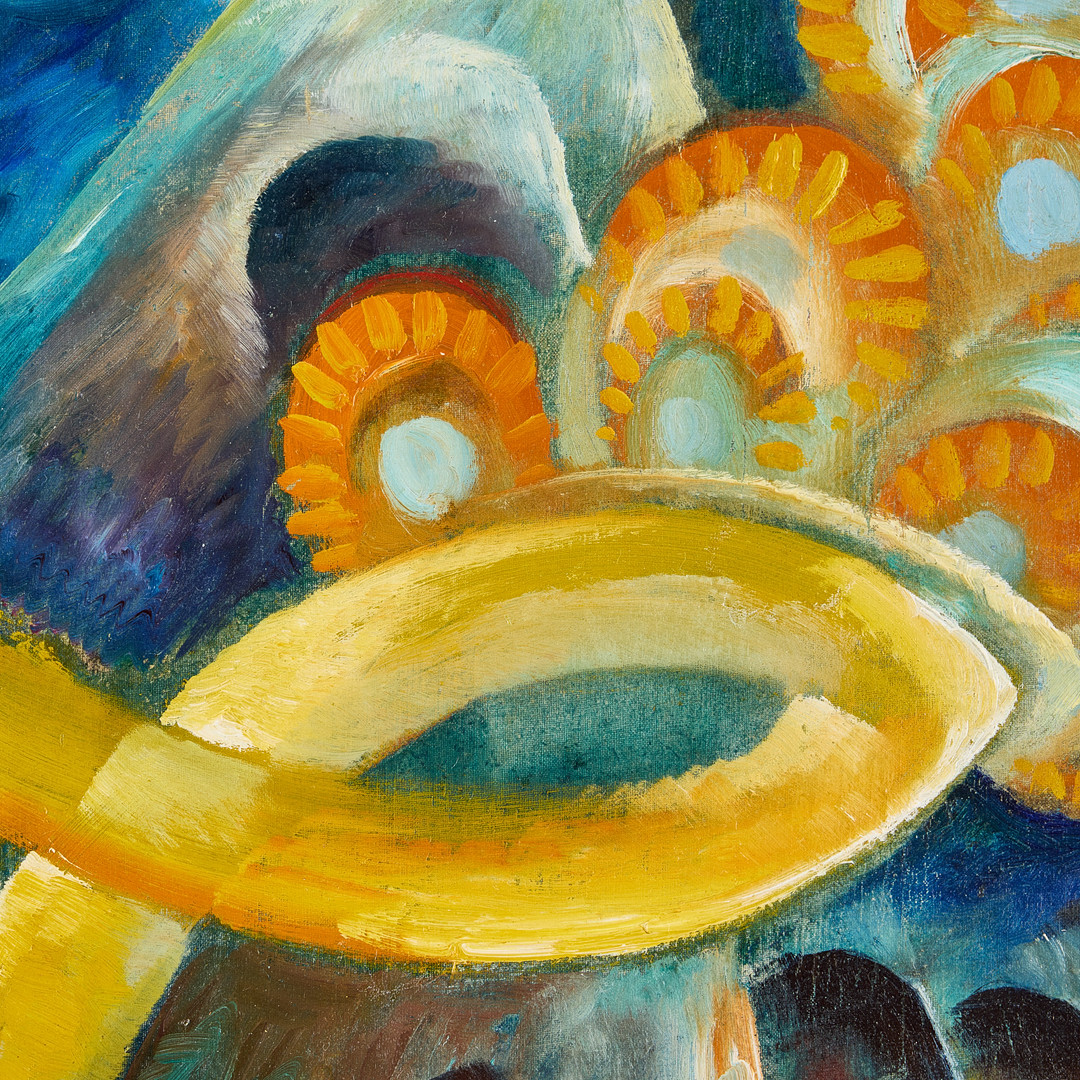
Oil on canvas mounted on panel, 68 x 56 cm, including frame 72.5 x 60 cm. Signed G A-N. Executed in 1919.
PROVENANCE
Elsa Holm, Stocksund. Acquired in the mid-20th century. Thence by descent within the family.
EXHIBITED
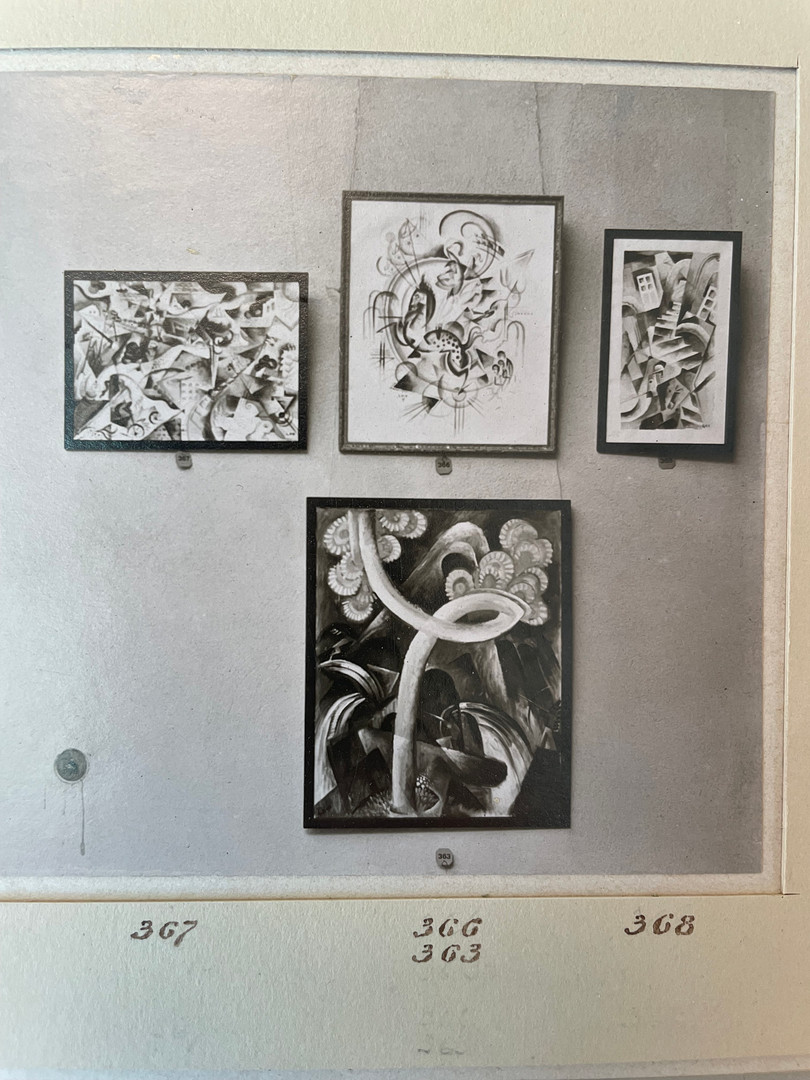
Liljevalchs Konsthall, "Februarigruppen 1919", 15 February - 23 March 1919, cat. no. 363.
In the spring of 1919, Gösta Adrian-Nilsson, GAN, had lived and worked in Stockholm for just over two and a half intense years. From the very first moment, GAN had thrown himself into the capital's swirling nightlife: “The three weeks in Stockholm are a kaleidoscope. It has been a party in every color - a vortex steaming with whiskey, punch, good food, and cigarettes. Now it must end. The evening at the opera café with Jolin - innocent - was the best. Grünewald was there […] and Pär Lagerkvist sat down by the entrance together with a lush Danish lady” (diary 9/10 1916). Nine days later, GAN executed a drawing (Kulturen, Lund) which, interestingly enough, is also annotated “Berns” (where GAN liked to spend his evenings when his meager finances allowed), depicting two rough-hewn sailors at the entertainment establishment.
Sailors would come to play a central role in GAN's artistic production during his Stockholm years, where he, to a large extent, let them become symbols of his repressed homoerotic longing. Sailors had, incidentally, already appeared in his painting in compositions such as “Den vita och den blå matrosen” (The Tangen Collection, Kunstsilo, Kristiansand, Norway), 1915, and “Matros ombord” (The Tangen Collection, Kunstsilo, Kristiansand, Norway), 1916, both executed in Lund. After moving to Stockholm, however, he became almost manically fixated on them, not least after his intense infatuation with torpedo boat no. 629 of the Royal Navy's 2nd stoker company, Edvin Andersson. GAN's focus on sailors during these years would, as is well known, result in the legendary exhibition “Sjömanskompositioner” at Gummessons on Strandvägen in Stockholm in the spring of 1918.
However, the sailors were not the only homoerotic ideal men for GAN. Already in his youth, he had, like many other young boys, been amused by literary depictions of “Indians” (or as we prefer to say today: indigenous peoples of the Americas). GAN devoured adventure novels about these “savages” (again, a term we avoid today) whom he perceived as strong and noble representatives of a culture that appeared exotic (and erotic; GAN naturally perceived these men as “sex objects”).
GAN reconnected with this theme when he celebrated Christmas with Egon Östlund in Motala in 1915. On this occasion, he received James Fenimore Cooper's “Indian books” as a Christmas present from Egon. During this Christmas holiday in Östergötland, GAN read “The Last of the Mohicans” and “The Deerslayer” while he began writing his diary. GAN's diary, a simple lined black oilcloth book with red edges (preserved in the GAN archive at Lund University Library), was “christened” by the artist, like an “Indian name”, as “Svartbok” (Black Book). On Epiphany 1916, GAN wrote: “May you also be an Indian in your essence - never forget a good deed, never forgive an injustice. The restrained, grim, and proud nature of these slim-waisted, steel-muscled men and youths grips me constantly with the same force”.
In January 1916, GAN was in full swing painting extraordinary compositions on the theme. The foremost of these canvases, “Indianer på krigsstigen” (private collection), was completed on 4/4 1916. On this occasion, however, he had also finished the famous “Matros ombord”, “the white sailor in a chaos of lines” (diary 29/2 1916, it was apparently a leap year….). With minor exceptions, GAN would also concentrate on “Sailor motifs” and “City syntheses” over the coming years.
In the spring of 1918, however, GAN returned to the “Indian motifs”. The question is why? One plausible theory is that he was “exhausted” of “sailor motifs” (which he had focused on wholeheartedly ahead of the exhibition at Gummesson). Added to this is the fact that his relationship with Edvin Andersson was coming to an end. An emotionally drained and disappointed (“Sjömanskompositionerna” had not sold as he had hoped, and Edvin did not seem very interested anymore…) artist took refuge this spring in the capital's cinemas (GAN loved going to the cinema) where he preferred to watch “Wild West films”. It is easy to believe that GAN now found new inspiration in this material. In February, he painted, for example, “Indianstrid” (Hallands Konstmuseum, Halmstad) and “Cowboys och hästar” (Moderna Museet, Stockholm).
In the spring of 1918, GAN writes in his diary (24/1): “I have never been at sea. Never have I felt the cold, sooty surface of a deck's turret, or the strike of a wind-filled sail over my head. […] Indians, cowboys - the same. Men bred to will, courage - patience! Unwavering self-reliance. In my loneliness, and only in that, can I feel the rustle of the dark forests, hear the sound of bows among the leaves. There I can experience the leap of the leather-clad boys in the saddle - the scent of the wild prairie where the buffalo herds graze. In the end, I am, however, a romantic - of a strange kind”.
“Cowboys” and “Indians” thus return at this time as competitors to the “Sailors”. GAN had already executed an extraordinary watercolor of an “Indian” (private collection) in 1913 and further developed the theme during 1916 and 1918. Now, this last spring in the capital, he “burns off” a couple of final “Indian motifs” before he, via southern Sweden, moves to Paris (and begins a completely new phase in his artistry) in the summer of 1920.
In 1919, GAN exhibited no less than three times at Liljevalchs konsthall in Stockholm. At the “Autumn Salon” in October (when GAN had already left Stockholm…), nineteen works of art were shown. Before that, the exhibition “Stockholm i bild” (May-June) had included four numbers. The largest presentation of GAN in terms of the number of works this year was, however, “Februarigruppen” (February-March), which presented thirty-three works (of which three were watercolors)!
This exhibition showcased early masterpieces such as “Matros ombord” from 1916 (misdated in the catalog…) and “På pansarbåten” from 1917 (Eskilstuna konstmuseum). In addition, there were remarkable paintings from 1918 such as “Skapelsen” (private collection), “Maskinarbetaren” (Norrköpings konstmuseum), and “Min ateljé” (private collection).
The exhibition catalog lists five works of art (including one watercolor, “Trappan”) from 1919 (the varnish can hardly have had time to dry…). Of the four oil paintings, to my knowledge, two are documented in the literature: “Operationen” (cat. no. 364) and “Abstrakt I” (cat. no. 365). The remaining two went under the following designations: “Indianskt” (cat. no. 362) and “Solträdet” (cat. no. 363). The title “Indianskt” clearly shows that GAN, even in the spring of 1919, found inspiration in his romanticized image of the indigenous peoples of America.
In my assessment, finally, the current work of art (which also depicts “Indians”) at the present auction should be identical to “Solträdet”. This assumption has also, in retrospect, been confirmed by a black-and-white photograph depicting the present work of art at Liljevalchs in the spring of 1919.
The tree in question may seem to constitute a somewhat strange element in the composition, but it is, in this context, of interest to remember that GAN was often something of a man of contradictions. For several years, he experimented with different styles and forms of expression, nourished by a longing to constantly develop his artistry. 1919 was also the year when GAN, after great struggles, would finally reach a completely non-representational, or non-figurative, painting in the composition “Abstrakt I” (private collection).
That GAN was a man of contradictions is also evident from his reading habits. Simpler entertainment literature (such as James Fenimore Cooper's novels) was interspersed with significantly “heavier” theoretical literature. In 1919, GAN was interested, for example, in theosophy (the fashion philosophy among many searching artists, not least Hilma af Klint, and authors around the turn of the century 1900). This occult-oriented worldview, in strong reaction against positivist science and materialistic philosophy, had previously been called “one of the great spiritual movements of our time” by GAN's great role model, Kandinsky. In Halmstad, in the spring of 1920, GAN, together with Egon Östlund, listened to a lecture titled “Yoga - the way to God” before walking home with a couple of theosophical writings under his arm. From the Theosophical Society in Stockholm, he ordered six more brochures by the “high priestess” of theosophy, Annie Besant. One of these was titled “The Path of Discipleship” (Livsstegen), which also became the name of GAN's first purely theosophical painting in February 1920.
It is by no means impossible that GAN, already in the spring of 1919, had begun his exploration of theosophy. If so, it is easy to perceive the strange “sun tree” as a result of this newly awakened interest. The design of the tree can also, as mentioned, be a result of the artist's ambition to abstract his motifs this year.
That “Solträdet”, according to information, at an earlier stage hung at a theosophical collective in the Stockholm area (donated by the artist?) can also indicate that GAN perceived the motif as an artistic expression of his spiritual search during this period when he increasingly questioned his previously dissolute life in Stockholm and sought a hidden deeper truth in human existence.
Pedro Westerdahl
GAN specialist
Curator and catalog editor for the exhibition “Gösta Adrian-Nilsson. Sjömanskompositioner - färgens dramatik och stadens dynamik” at Sven-Harrys konstmuseum, Stockholm 2019. Author of a new upcoming biography on GAN, currently in progress.
On jälleenmyyntikorvaus.