Josef Frank, ”Plan de Paris”
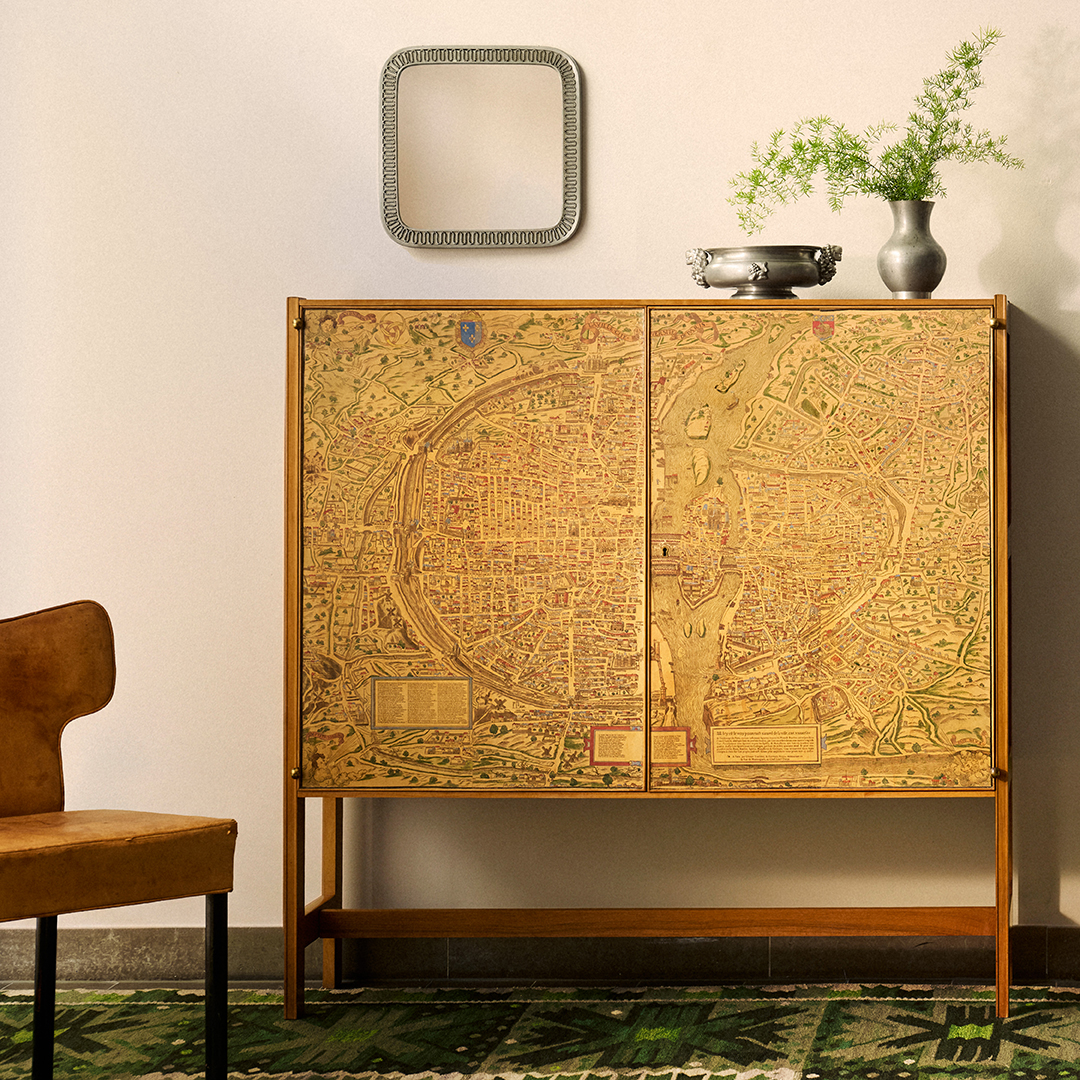
The Design Sale presents a rare cabinet by Josef Frank for Firma Svenskt Tenn, upholstered with Truschet and Hoyau’s map of Paris from 1550. The cabinet unites Frank’s playful idiosyncrasy with the covering technique that he and Estrid Ericson developed together, and its motif carries a history that stretches from Renaissance Paris to the city’s cultural rebirth after the war.
When Josef Frank began his collaboration with Estrid Ericson in the spring of 1934, he was already established as one of the leading architects and furniture designers of his time, and his success would continue throughout the more than three decades he worked at Firma Svenskt Tenn. Among the most distinguished, and at the same time playfully idiosyncratic, pieces of furniture created during this period are the exclusive cabinets and chests of drawers covered with various prints or textiles.
These were often a direct result of the creative interplay between the two, and their origins can be traced to before the collaboration began. Before Frank arrived in Sweden, he had made cabinets covered with various textiles for his firm Haus & Garten. Meanwhile in Sweden, Estrid Ericson, on an excursion with the poet Bo Bergman to Linnaeus’s Hammarby, had seen Linnaeus’s bedroom, its walls papered with hundreds of botanical plates. The experience inspired her to have the sleeping alcove in her new flat, designed by Uno Åhrén, papered with watercoloured copperplate engravings from a French flora.
After a few years, their collaboration resulted in the joint innovation of covering cabinets, and later also chests of drawers, with floral motifs. Initially, plates from Palmstruch’s flora were used, and at a later stage from Lindman’s flora. This covering technique became a recurring feature in the production of exclusive furniture. The execution could be varied through different models and materials such as chintz and leather or, more rarely, through printed plates with less common motifs such as birds or monkeys.
Among the rarer motifs are cabinets covered with printed maps. Between 1937 and 1943, a small number of cabinets were made covered with Georges Peltier’s map of Paris, and in 1952 a cabinet with a map of London was exhibited at Nationalmuseum. That the present cabinet was also covered with a map is closely connected with the interests of its first owners, as it was acquired by a professor’s family with a passion for both cartography and history. That Frank here returns to Paris in particular as a motif raises the question of what lay behind his fondness for the French capital. The choice of motif may well be explained by the personal preferences of both the history-minded client and Frank himself. Frank’s connection with the city was beyond doubt, not least through his participation in the world exhibitions of both 1925 and 1937.
If the perspective is widened beyond the purely personal, however, the motif appears exceptionally well chosen in light of the situation the city was in at the time the cabinet was made. Truschet and Hoyau’s map of Paris from 1550 depicts a detailed and vibrant city with winding streets and famous landmarks at the height of the French Renaissance, when Paris was one of Europe’s central cultural hubs and melting pots. This historical image aptly mirrors the city’s rebirth in the early 1950s, when Paris, after the end of the war, once again emerged as a leading intellectual and cultural centre. It is a parallel that is unlikely to have escaped the intellectual professor’s family.
One should not, however, overlook Estrid Ericson’s possible influence on the creation of the upholstered cabinet; the Flora chest of drawers was, after all, their joint creation. Ericson liked to visit antiquarian bookshops in her search for material and inspiration, where among other things she found ‘floras’ whose plates she cut out to cover cabinets and chests of drawers. The copperplate engravings for the aforementioned cabinet with monkeys, taken from the Comte de Buffon’s Histoire Naturelle of 1749, were one such find. It cannot be ruled out that she also came across the present map by chance – an example of what Frank himself would later describe as the role of chance in interior design: an accidentism.
Josef Frank, ‘Plan de Paris’, cabinet, Firma Svenskt Tenn, model B2144, walnut, the doors upholstered with Truschet and Hoyau’s map of Paris.
Rectangular on a high stand, brass hinges, the doors with thin walnut mouldings and upholstered with a hand-coloured facsimile of Olivier Truschet and Germain Hoyau’s map showing Paris in 1550 (the so-called ‘Basel map’, as the only known original is held at the Universitätsbibliothek Basel). Two shelves inside.
Height 132 cm, 132 x 38 cm.
ESTIMATE:
2,000,000 – 3,000,000 SEK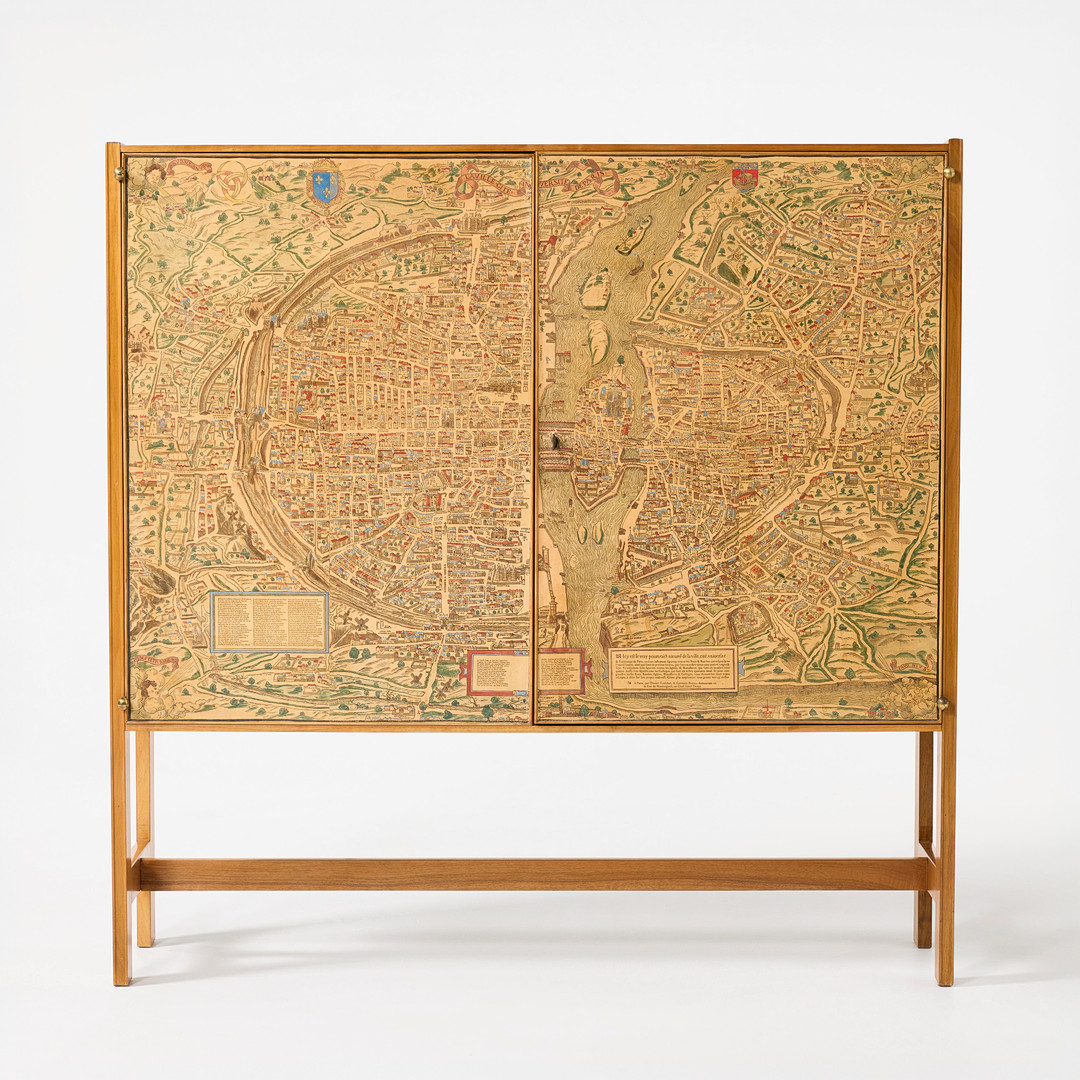
Viewing
October 16–26
Nybrogatan 32, Stockholm
Opening Hours
Monday–Friday 10am–6pm
Saturday–Sunday 11am–4pm
Live Auction
October 27, starting at 11am CET
Furniture, carpets, lighting, ceramics and glass, lots 1–416
October 28, starting at 10am CET
Silver and jewellery, lots 417–511
Enquiries & condition reports



Ajankohtaista
Lisätietoja meistä