







88. THE DECK LOGBOOKS OF THE VEGA EXPEDITION.
| Valmis | 10 Mar 2026 |
|---|---|
| Huutokauppanumero | 88 |
| Kohdenumero | 4758357 |
| Korkein tarjous | 3 350 000 SEK |
|---|---|
| Huudetaan | Valmis |
| Sijainti | Stockholms Auktionsverk Nybrogatan 32 |
| Kohde on huudettu | |
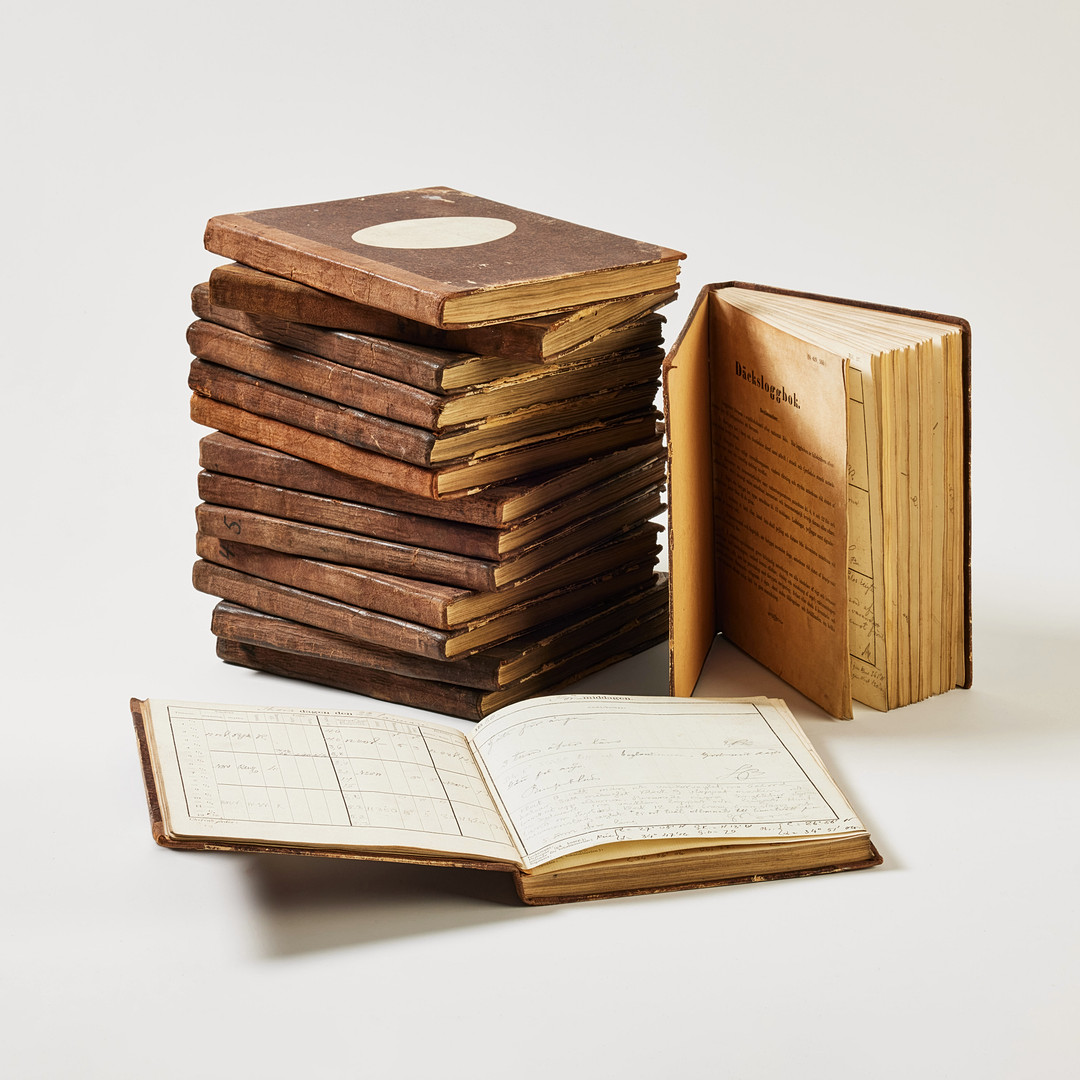
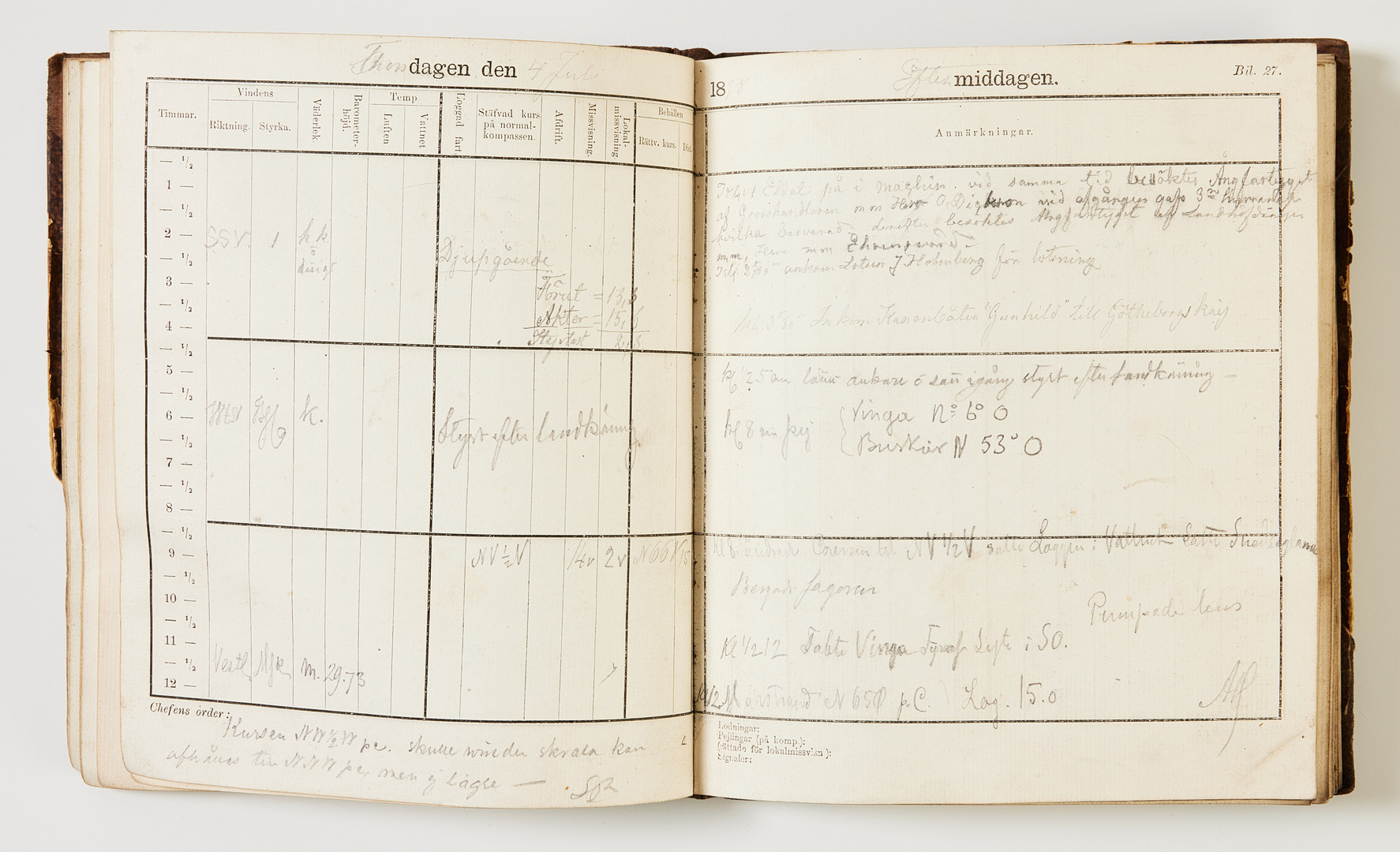
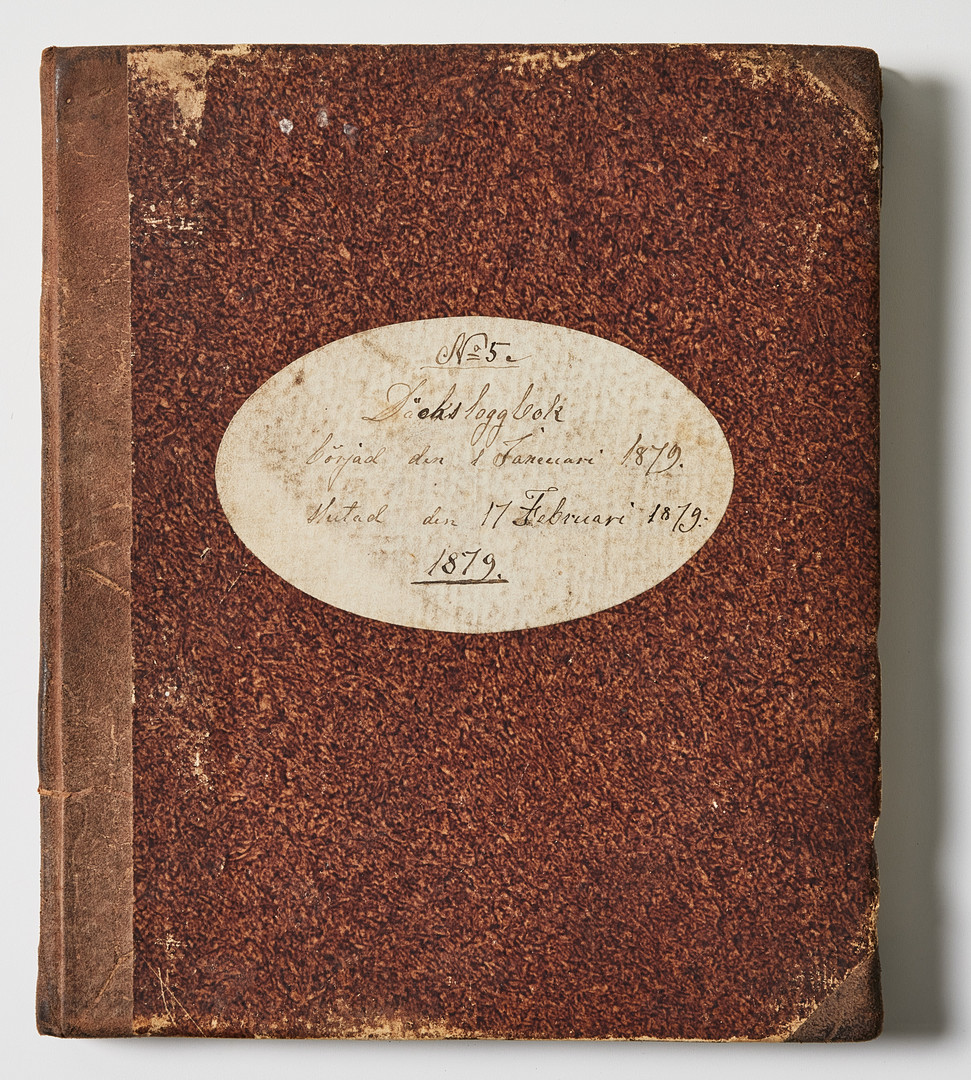
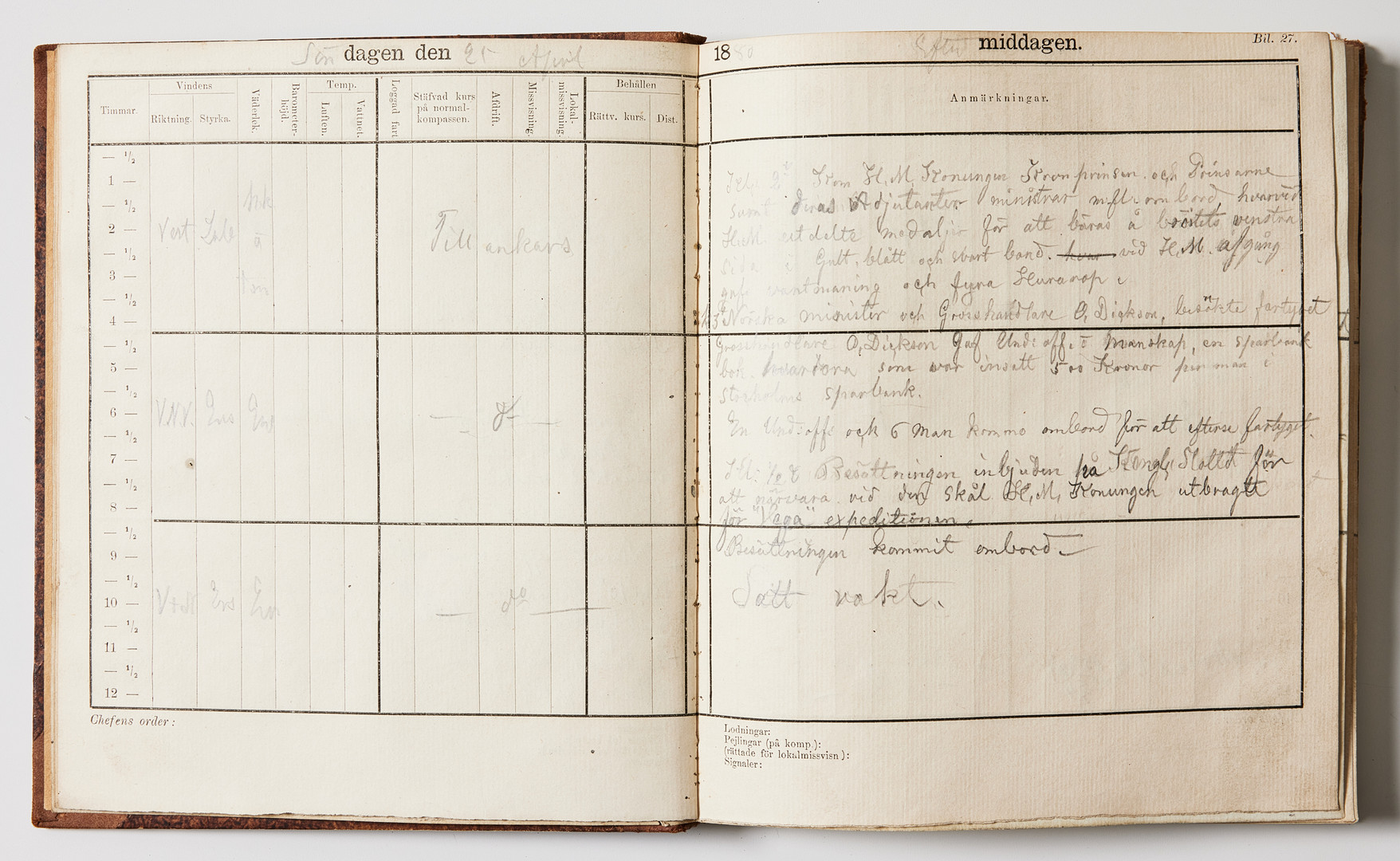
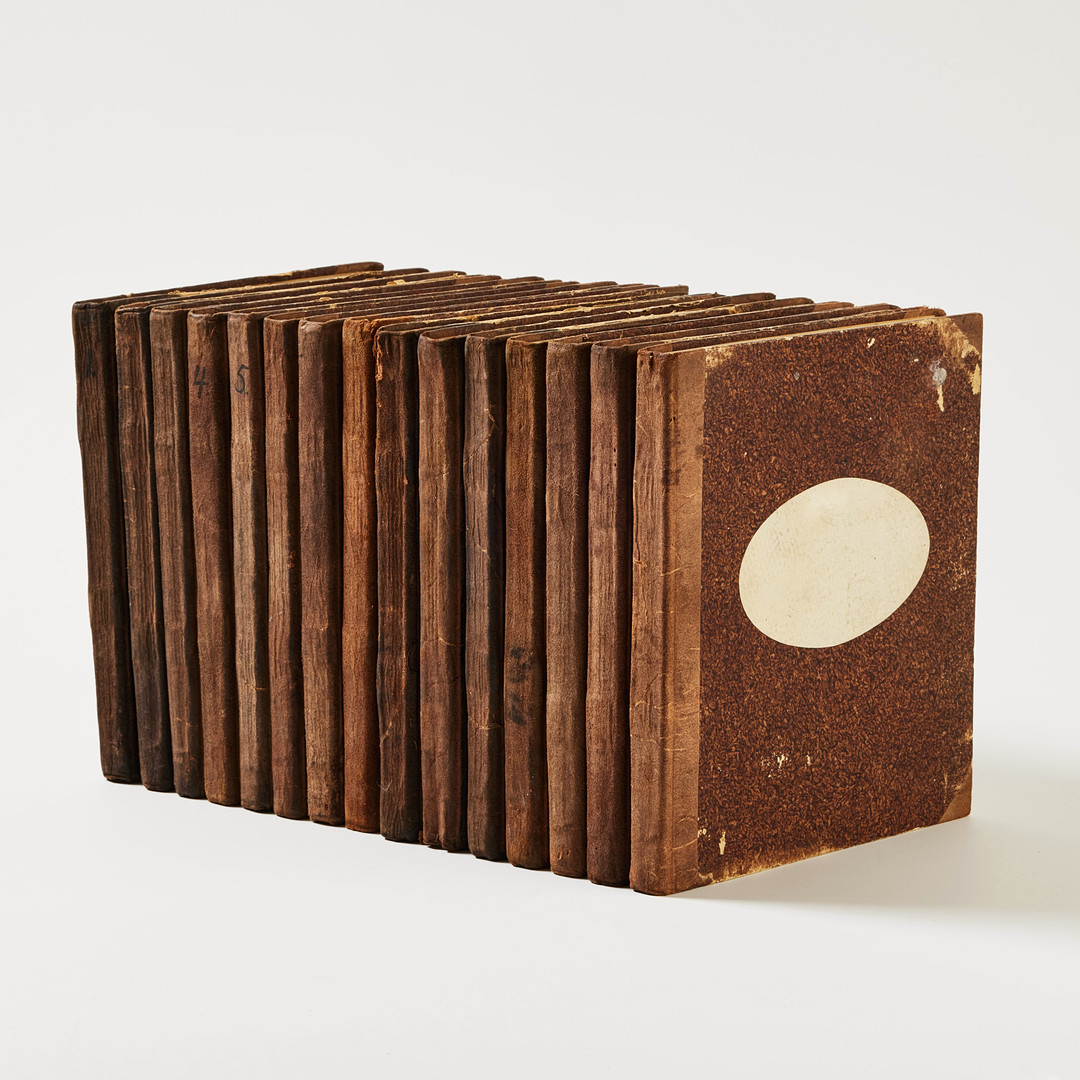
Fifteen uniform volumes in brown half-leather bands with sticker-marbled binder paper and oval paper labels on the forward sleeves, most numbered and bearing dates on the labels, three volumes also numbered on the backs, the inlays throughout with pre-printed tables and fields filled in by hand, mostly in pencil, sometime in ink. The first page of each volume with the heading “Tyre Logbook”. Mostly 196 p. per volume, however, the number of pages diverges in a few volumes. Partly worn, sunburnt and slightly mottled, first volume with a broken corner on the front sleeve and consequent discoloration on the first leaf, another volume with break marks on the bindings, a volume partially detached in the binding. Watch Louis Palander of Vegas archive.
In the first logbook there is a note for Thursday, June 20, 1878, at six o'clock in the morning: “Embarked Crew. Hoisted Flag and Pennant.” In the last logbook we read for April 24, 1880 that Vega “Arrived at Stockholms ström at ¼11 pm received with Fireworks etc.”. Between these two notes, the nearly 3,000 pages hold the entire Vegas adventure, day by day, hour by hour, in notes jotted down by some of the drama's protagonists, just as it unfolded.
The detailed data on weather, wind, temperatures and ice could still be of climate-historical interest, notes on boat and sleigh issues tell us something about how the scientific work was carried out, the crew's food rations and part care tell about the expedition's everyday life, and, of course, what can be said to be the main task of the logbook, precise accounts of which sails are hoisted and torn, when the steam engine is on fire and which ports are concerned.
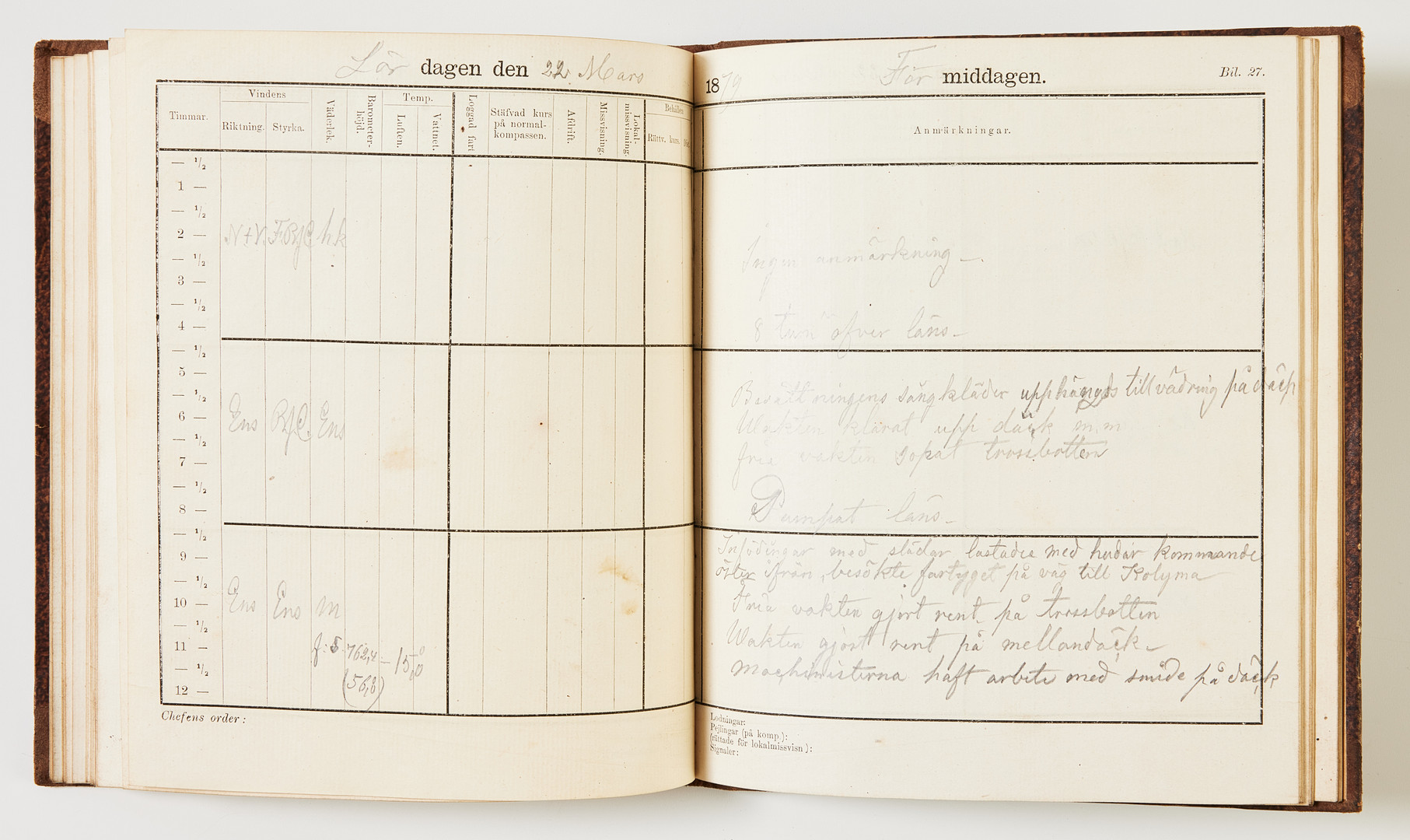
Although Vega did not go under a flag of war, the expedition was largely organized according to Navy systems and procedures. The deck logbooks used were therefore the same as those used in the Navy. The logbooks follow the on-board guard system and are divided into four-hour passes, in which the commanding officer on duty has recorded the events that had significance during each guard.
The deck logbooks' notes were then progressively transferred to the official larger-format logbooks to be preserved for posterity. In the case of naval military expeditions, these were preserved in the archives of the Navy. The deck logbooks thus became redundant, and very few have been preserved to posterity.
When it came to the Vega expedition, Nordenskiöld took great care of the cleanly written official logbooks, they are now preserved at the Royal Swedish Academy of Sciences Centre for the History of Science. But Louis Palander kept the tire logbooks that he and his fellow officers kept along the way, and those are the ones on offer here.
Tyre logbook number 1
June 20, 1878 — August 7, 1878
196 pp.
This volume is worn, with a broken off corner on the front sleeve. Here we follow Vega from the preparations in Karlskrona, over loadings and embarkations in Copenhagen and Gothenburg, in storm after the Norwegian coast, via Tromso and Måsøya, across the Barents Sea, through the Jugorsky Strait and across the Kara Sea until Palander on 6 August “Anchored in a bay at Dicksons Island”.
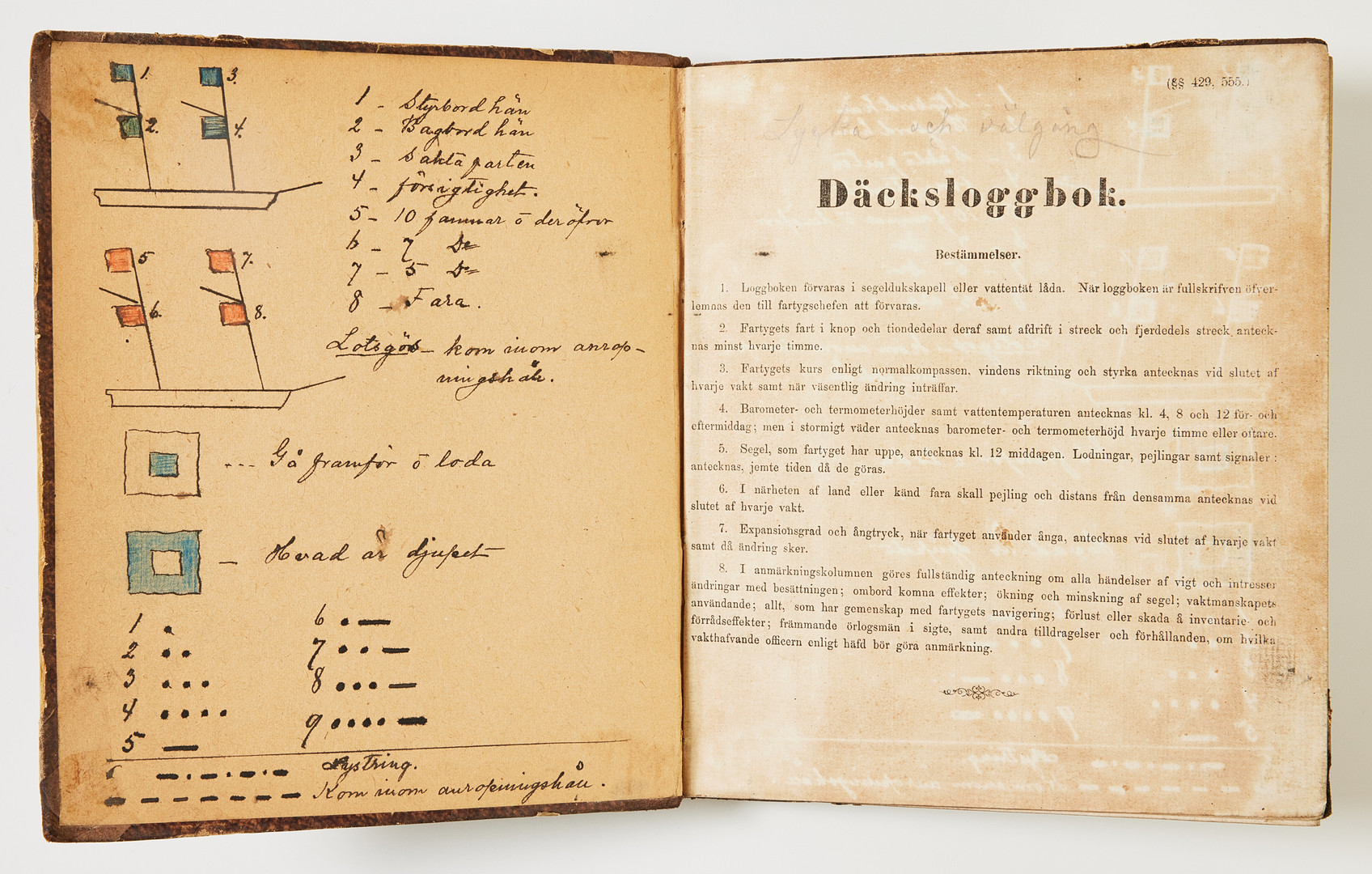
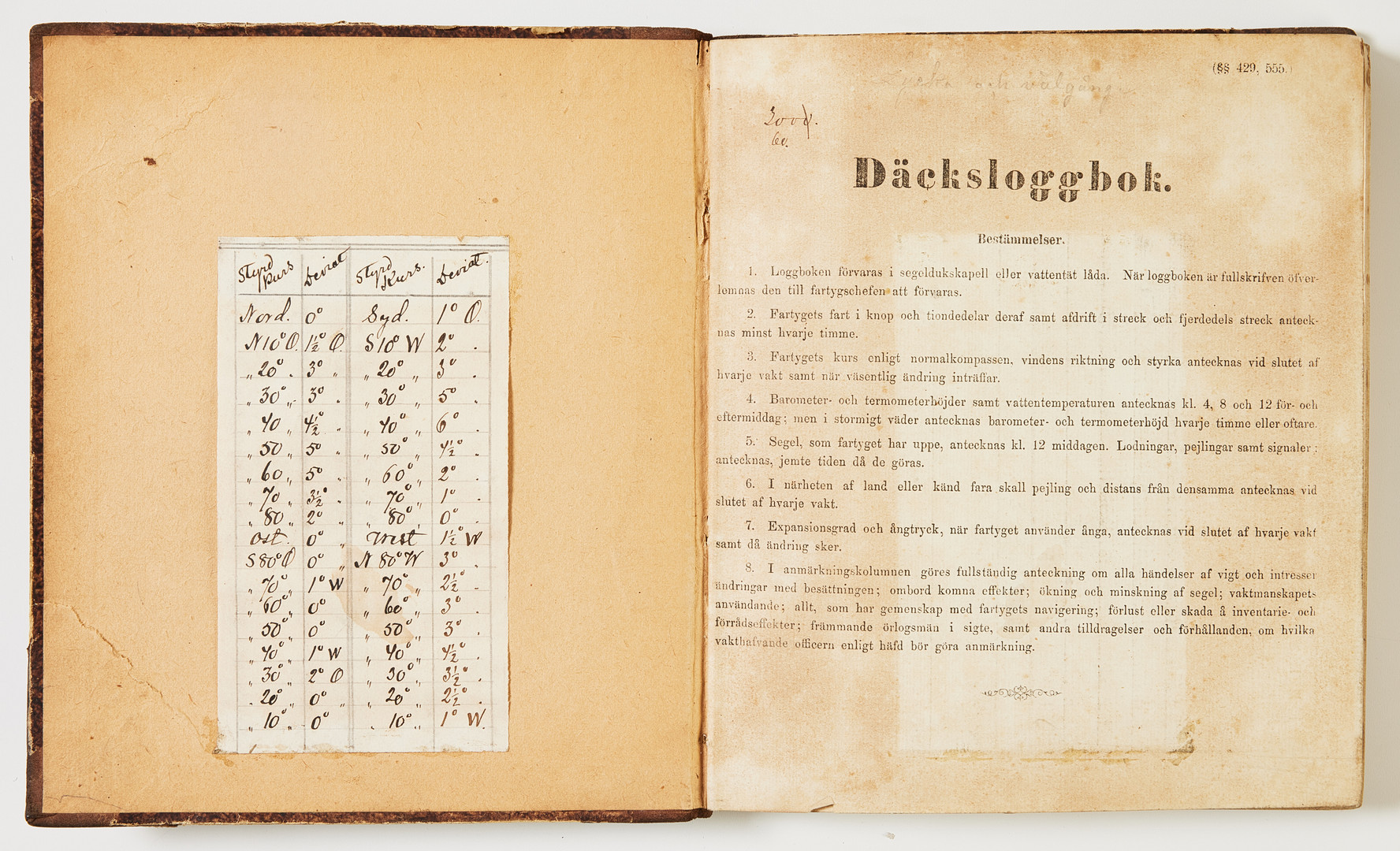
During part of this journey they were accompanied by the escort boats Lena, Fraser and Express, and on the inside of the front sleeve are marked flag signals in red and blue, as well as the Morse signals for “Lystring” and “Come within call”.
Also in the book is loosely inlaid a sheet with a transcript of accounts of renovation works at Vega, dated 1878-79.
Tire logbook number 2
8 August 1878 — 25 September 1878
196 pp.
On the first page of this volume, Palander has written a motto for the expedition: “Happiness and prosperity”. Here, too, flag signals are depicted on the inside of the front binder, including “Go ahead and plumb” and “What is the depth”.
Vega runs in this volume from Dickson Island, via Asia's northernmost point Cape Cheljuskin, past the Lena Estuary and down towards the Chuchter Peninsula. The sailing here was partly slow, and Nordenskiöld complains (for once) in his description of the Vega expedition: “The sailing along the north coast of Asia began to become somewhat monotonous. Even the most intrepid polar explorer can be sad for a long time on nothing but ice, ground and fog, and no fog, ground and ice.”
It becomes clear from the logbook that what was monotonous for Nordenskiöld was full of activity for the command on board. No charts could be used east of the Tajmyr Peninsula, and the logbook is filled with notes on landings, land views, shallows and ice. Those now for the logbook are for the most part Eric Brusewitz, Andreas Hovgaard and Louis Palander, but even the Italian lieutenant Giacomo Bove has signed some occasional guard.
Tire logbook number 3
September 25, 1878 — November 12, 1878
196 pp.
The first few days of this volume describe some navigation, and also one of the expedition's few accidents, when the rudder spikes against the underwater ice and “the helmsman (Båtsman af 1:a Ölands Komp: No 2 Lustig,) was thrown over the rudder, thereby sustaining several major and minor blows in the head between the shoulders and the right leg.”
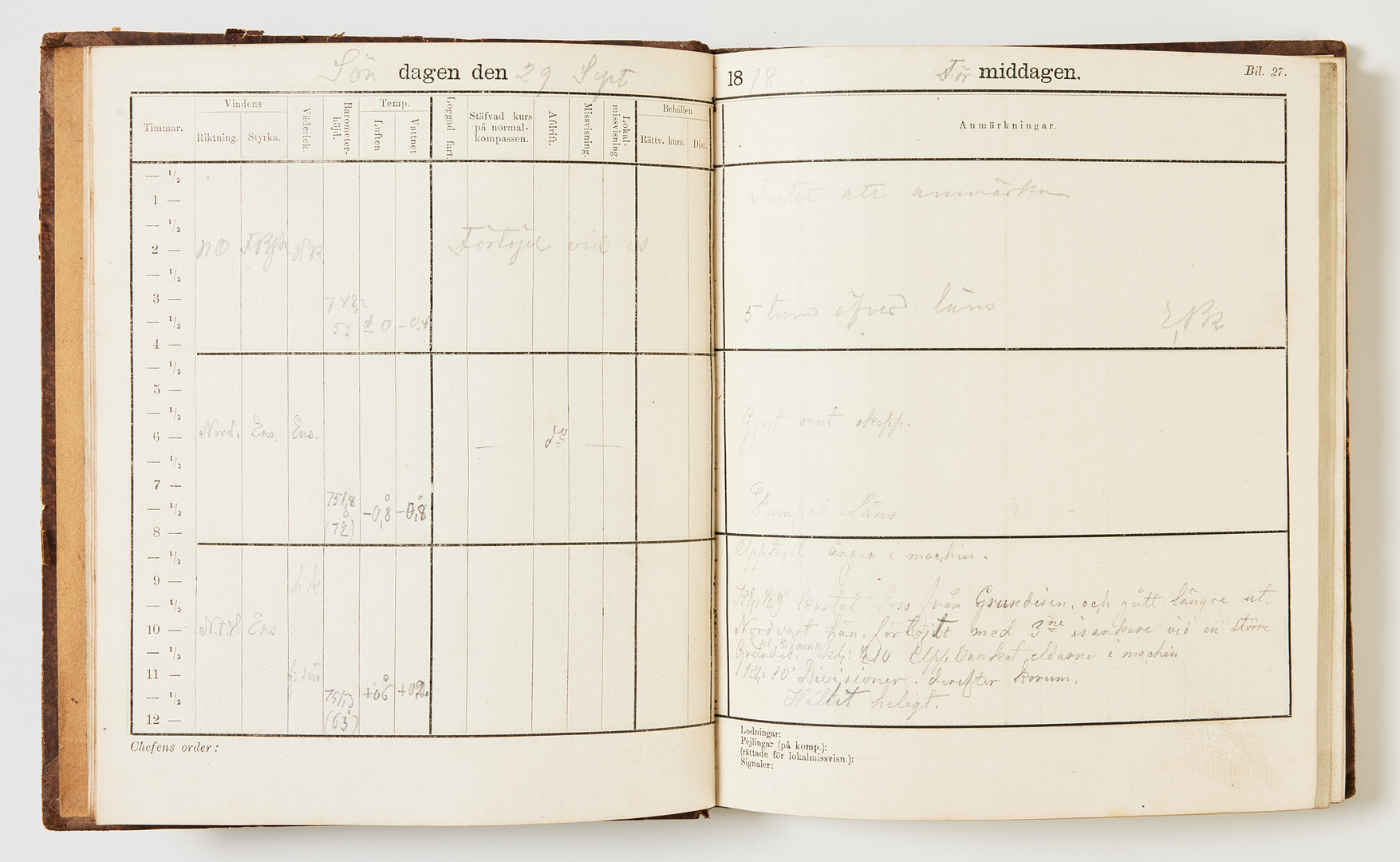
On September 29, the drama will be over. Palander logs that one “moored with 3ne ice anchors at a larger Grundis of 5 bosoms”. That mooring would be left for nearly 10 months. Vega was frozen solid.
During the freezing period, it is recorded, among other things, how the crew saws up and transports ice for the construction of a small ice house on land. The icehouse was constructed by Palander and housed the expedition's observatory of magnetism. Since the observations were to be made continuously hour by hour, and on some days every five minutes, a shelter from the Siberian ice cold was needed during the long passes.
Among other things, the expedition participants issued ashore, visits by local residents and the distribution of, for example, “2 pairs of woolen socks and 1 pair of mittens per man” to the crew are recorded.
Tire logbook number 4
November 13, 1878 — December 31, 1878
200 pp.
During this period, Vega was frozen. Weather, wind, air pressure and temperature were recorded every four hours, as well as the water level over the county and the recurrent bilge pumps. Even the thickness of the ice at the ship was sometimes noted, on 2 December it was 1.9 feet.
The scientific work did not rest: “Free time ashore by sleigh, to haunt legs for the science” reads a typical note.
On other days, they stow provisions, stretch the tent over the deck or set up ropes for the road to land, for guidance in the polar night.
The last page of the logbook lists what was spent on New Year's fireworks at midnight: five loose cannon shots were fired, ten rockets were thrown, and in addition six blinking beacons of different lights and three burners were set off.
Tire logbook number 5
January 1, 1879 — February 17, 1879
196 pp.
On the first page is inscribed “Peace and happiness”. Vega lay frozen at Pitlekaj and the crew had fun with target shooting with Remington rifles, 5 shots per man. Also recorded are the various lectures given to the crew by the scientists on board. Frans Kjellman lectures on a Saturday afternoon in botany and both A. E. Nordenskiöld and Anton Stuxberg give lectures on voyages of discovery. The one who speaks of the Northwest Passage on January 25, however, is “The Chief,” thus Palander himself.
It is always recorded in the logbook whether the crew has been allocated extra provisions (or rum). On January 27, something vital was recorded: “Started dispensing cranberry juice to the herd 1 kbt per man daily”. This juice was one of the sources of vitamin c that allowed the crew of Vega to make it through the polar winter without scurvy.
Tire logbook number 6
February 18, 1879 — April 6, 1879
196 pp.
The motto of this logbook is solely “Happiness”. Vega is still frozen and the weather is often “Even”, that is, uniform or similar to the previous guard. However, some alternation occurs, for example, it can be noted both “yrsnow” and “sneyra”, which are two completely different phenomena, as Nordenskiöld explains in his depiction of Vega's fate. The strength and direction of the Northern Lights also enter the weather column.
In the spring the lectures continue, Stuxberg now talks about Zoology and Nordenskiöld about chemistry. In the absence of better employment, the distance from Vega to the icehouse is measured on land: 4777.5 feet.
A staircase of snow is built up to the ship, which was probably handy for the merchant travellers noted coming to visit with sleds fully loaded with hides. Reports say there is open water to the east, but nothing like that can be seen.
At this time, a number of sleigh journeys inland are also undertaken, including by Palander and others, as they are also recorded.
Tire logbook number 7
7 April 1879 — 24 May 1879
196 pp.
Under the motto “Happiness and good luck” the weather, the work of the bilge pump and the usual activities are noted. Vega is still frozen. They receive visitors, chop up ice, patch and cook clothes. Reindeer meat is purchased from some tundra juks.
11 April was at least a good day for the sailor of Second Company number 22 Öman, who on this day was relieved of a “the punishment imposed upon him”. Exactly where the punishment was, however, is not specified.
A few days later, the crew undergoes sanity patterning, “no note”. To keep scurvy at bay, the herd is being evicted from May 20 with deer jam. Of the sauerkraut included for the same purpose, however, it is allowed to throw 22 pounds of sauerkraut overboard when it has become bad.
Tire logbook number 8
May 24, 1879 — July 9, 1879
188 pp.
Vega is still frozen during “Happiness and Prosperity”, but the freeze did not mean constant idleness. For example, the last four hours of the morning of June 6 were spent doing the following:
Set up the lookout on the big beam pole, occupied the steam trap on the deck from the middle deck. 3 men with sledges brought various effects ashore, used in the icehouse, Timmerman with his assistant drove and pitched outboard, the machinists forged on deck.”
On Midsummer's Eve they are hoisted to the public view “Flags and signals on the tops”, the crew gets extra butter and fresh reindeer meat for breakfast and then fresh potatoes and beer for both dinner and evening.
During this time Nordenskiöld also makes one of his longer issues on land, together with Frans Kjellman and Ernst Almquist. After another issue, it is noted that Nordenskiöld “came on board with various larger and smaller legs”.
Tire logbook number 9
July 10, 1879 — August 25, 1879
196 pp.
On 17 July Nordenskiöld with a company goes inland “to seek mam [m] out bones”, but they come back already on the night of 18 July, and the logbook expresses for once a question: “no mammoth bones found?”
And the next day, just after noon, it happens:
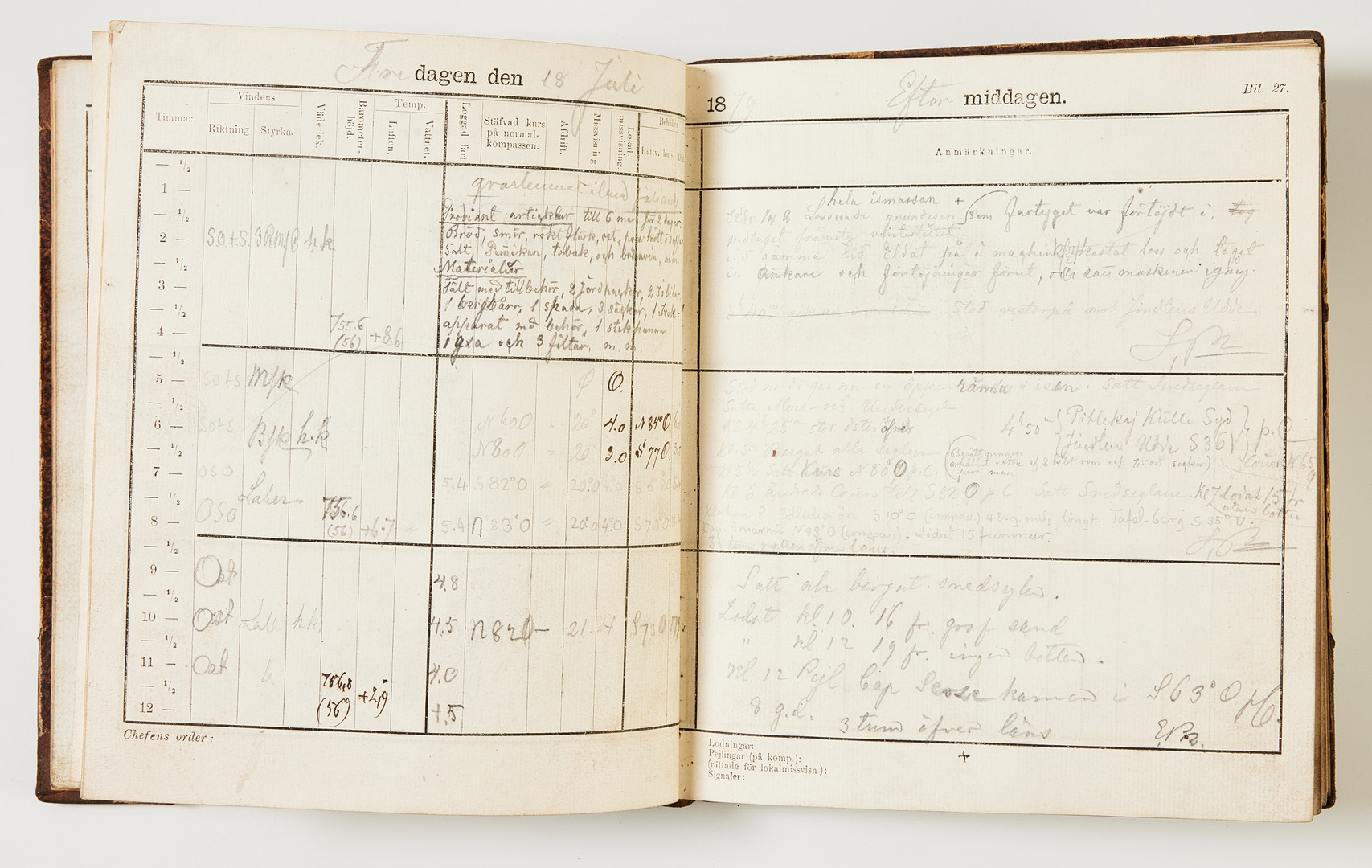
“Loosened the ground ice + the entire ice mass in which the ship was moored, took down the main winter tent.
at the same time Eldat on in machin. At ½4 I threw loose, and brought in anchors and moorings before, and set the machine up and running.”
Vega was finally unfrozen, after close to 10 months of freezing. This entry in the logbook is full of information and reflects well the combined relief and eagerness that Palander and the rest of the expedition felt when ships could be set in motion.
The day after, Andreas Hovgaard notes that the Arctic Circle is passed, and here follows an intense stage in the logbook, with both observations, issues and the usual ship news. Vega makes beach stabs on both sides of the Bering Strait and on islands in between. Now Giacomo Bove is also starting to take a lot of notes, and this in a Swedish that he obviously learned along the way.
On August 10, in the field of the “Order of the Chief” it is written that on this day the eating of cranberry juice ceases. In addition, the sauerkraut was running out, so white cabbage was to be served instead.
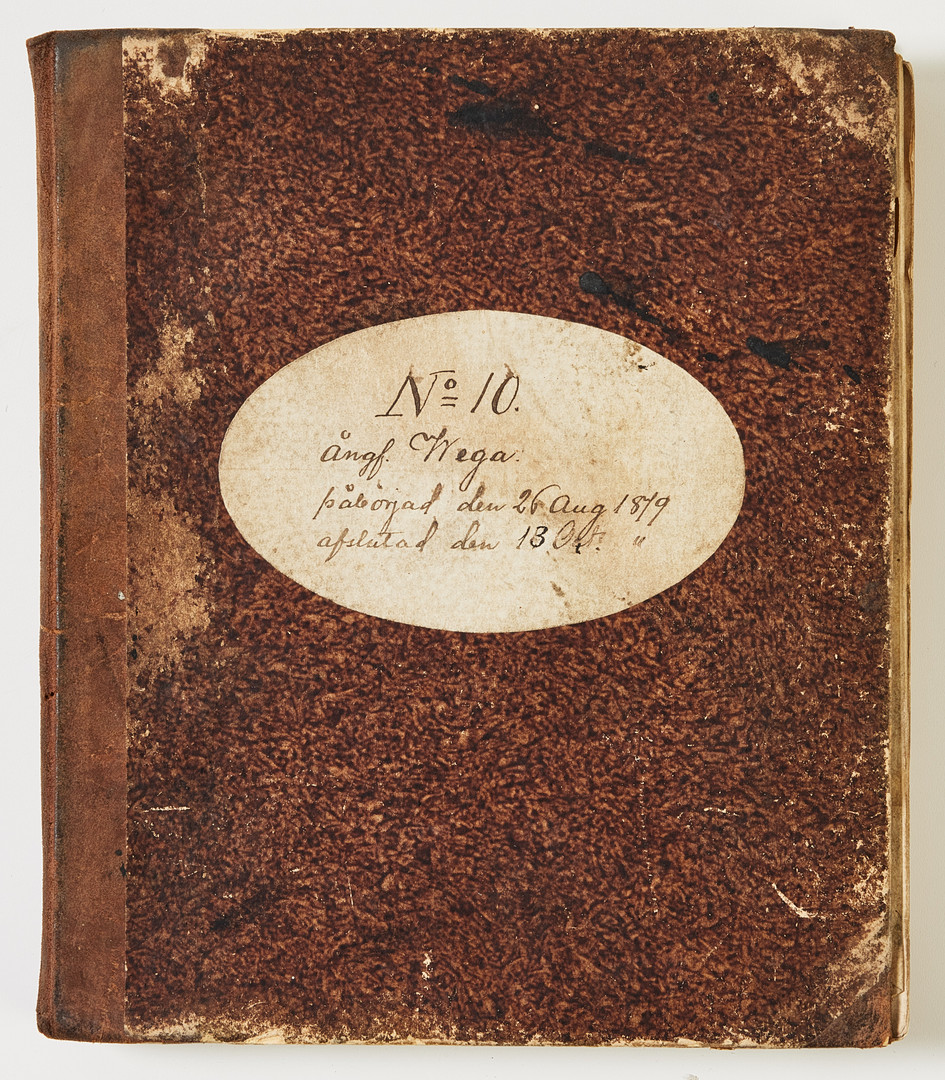
Tire logbook number 10
August 26, 1879 — October 13, 1879
196 pp.
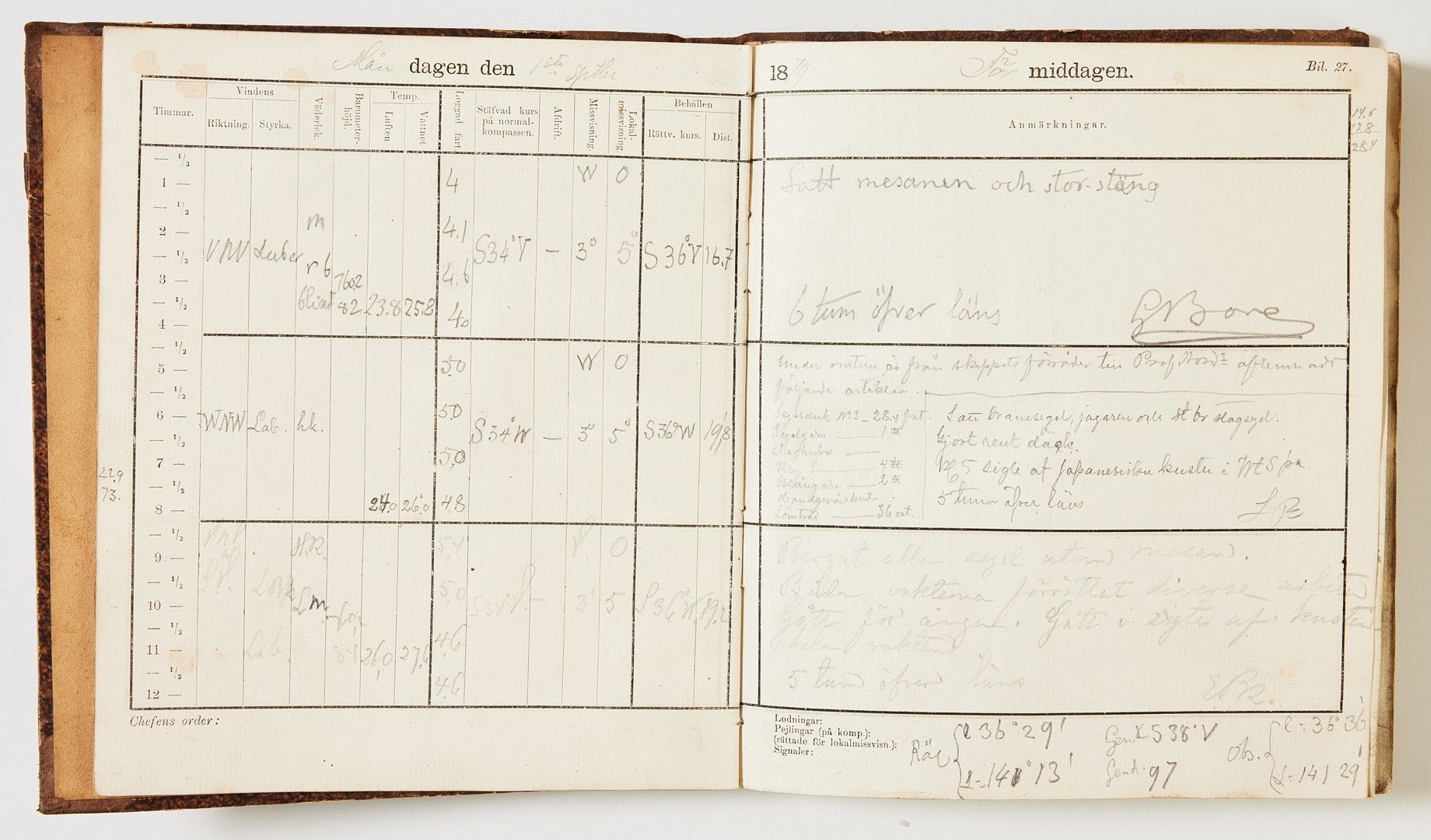
This is the logbook of the trip to Japan and much of the stay there. Here Vega is taken into dock in Yokosuka for a major overhaul, something that was much needed as she was both leaking and worm-stung. The propeller shaft is taken up from machine and laid on the quay, shipbuilders drive, painters and blacksmiths come on board, etc.
Here, too, the crew gets land laid off on several occasions, including for a trip to Tokyo. Whether the land permit contributed to certain disciplinary violations has not been established, but the lumberman Andersson, later named Vega-Sven, was released from the penalty imposed on 12 October.
Italian Giacomo Bove fights bravely with the Swede as he's about to sum up his guards:
“Steer after the lead of the soldering iron. Clock. ½4 met the English warship Glosner. Stopped machine for giving mail to a boat sent from this vessel.”
This volume has cracked anterior innerfals and is loose in the binding.
Tire logbook number 11
October 14, 1879 — November 28, 1879
188 pp.
During this period Vega runs from Kobe to Singapore, via Nagasaki, Hong Kong and Labuan. There is still some scientific work going on and bottom fauna is being drawn. You also sail diligently, but no longer need to be as worried about shallows as on the Siberian coast. On 11 November Andreas Hovgaard writes that he plumbed with two cannonballs on 375 fathoms of rope without a bottom.
The provisions are reviewed continuously, water is taken on board and joke pork is thrown overboard.
Tire logbook number 12
November 29, 1879 — January 15, 1880
196 pp.
On the route between Singapore and the Red Sea, stops were made at Galle in Sri Lanka and Aden in Yemen. New Year was celebrated at sea with extra allotments of “Cognak”, brandy and sugar.
Arriving in Aden, which was a busy port, Vega got a foretaste of the tributes to come. Before we even had time to anchor up “Gafs from the harbour lying in the harbour, the Italian Ång Korvetten Esploratore salute with 21 shots and the Swedish flag hoisted on Stortoppen”.
Tire logbook number 13
January 16, 1880 — March 3, 1880
196 pp.
On 3 February, Palander notes that he “steered into the Suez Canal following the pilot's direction”. After a canal trip with many stops, two days later you are in the Mediterranean on the way to Naples. As soon as the opportunity was given, on the southern coast of Italy, Bove notes with unmistakable picture and writing: “Prof. Nördenskïöld and Lojlieutenant Bove went with the starboard boat ashore to telegraph income af Wega”.
Once in Naples, salutes are once again given by the Italian Navy, and it is soon recorded as saying every day that visitors come aboard. Naples also invites the crew to both dinner and theater. The climax will come on 22 February when the Free Guard goes ashore to “visit the ruins of Pompeii” with a banked train.
Tyre logbook number 14
March 4, 1880 — April 21, 1880
196 pp.
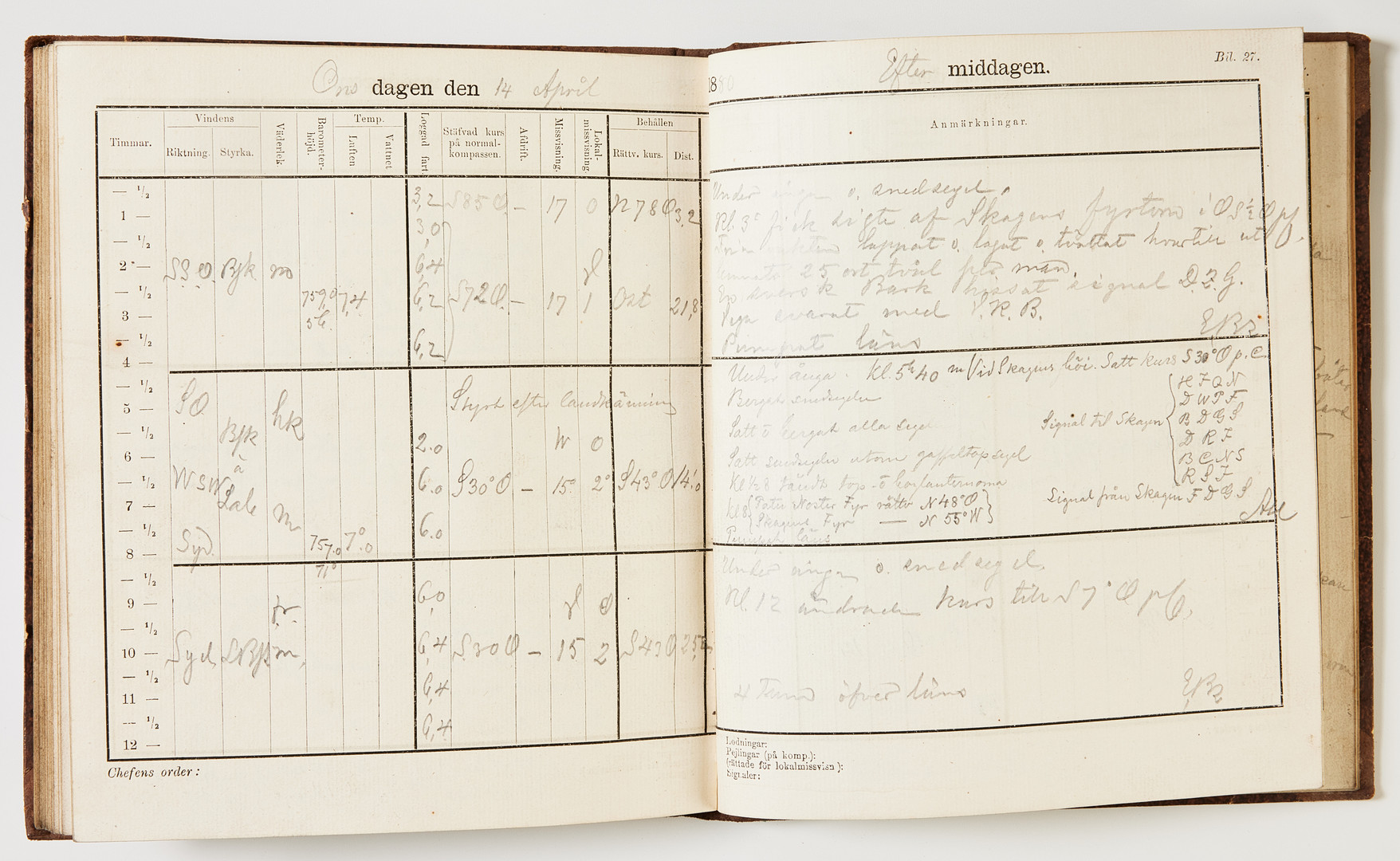
Nordenskiöld has called the trip up Europe a pleasure cruise. The fact that for some it was a bit of a pleasure can be seen in the logbook on 7 March, when the lumberman Andersson, “Vega-Sven”, off the coast of Spain, was sentenced to forfeit his extra salary due to drunkenness. Once in Copenhagen, Brusewitz reports that the lumberman Andersson has absconded from the ship.
When approaching the homeland, boats come to meet, salutes are shot and many visits are received, both with and without mentioning names. Most famous was, of course, on April 19th, the Danish royal family. The next day, Vega finally sets course for Stockholm.
Tire logbook number 15
April 21, 1880 — May 19, 1880
196 pp.
The final leg of the journey up through the Baltic Sea and into the Stockholm archipelago was the very finale of Vegas's triumph. The crew does the days before cleaning various parts of the ship, and on the morning of April 24, pilot E. L. Sundin from Dalarö on board to pilot Vega the last bit into the city.
Relay calls are made for the steamboats that have come out to meet Vega and anchor for a short time to enter just in the late evening, so that the illuminations and fireworks have the best effect. On April 25, the great festivities begin and both King Oscar II and Oscar Dickson come aboard and in the following days the crew are invited to several solemn dinners.
But the work is not over, unloading “assorted boxes for science” is one moment, dropping off the steam slop another. On 9 May, Vega leaves Stockholm for Karlskrona, where warships meet up with cheers and the fortress fires salutes.
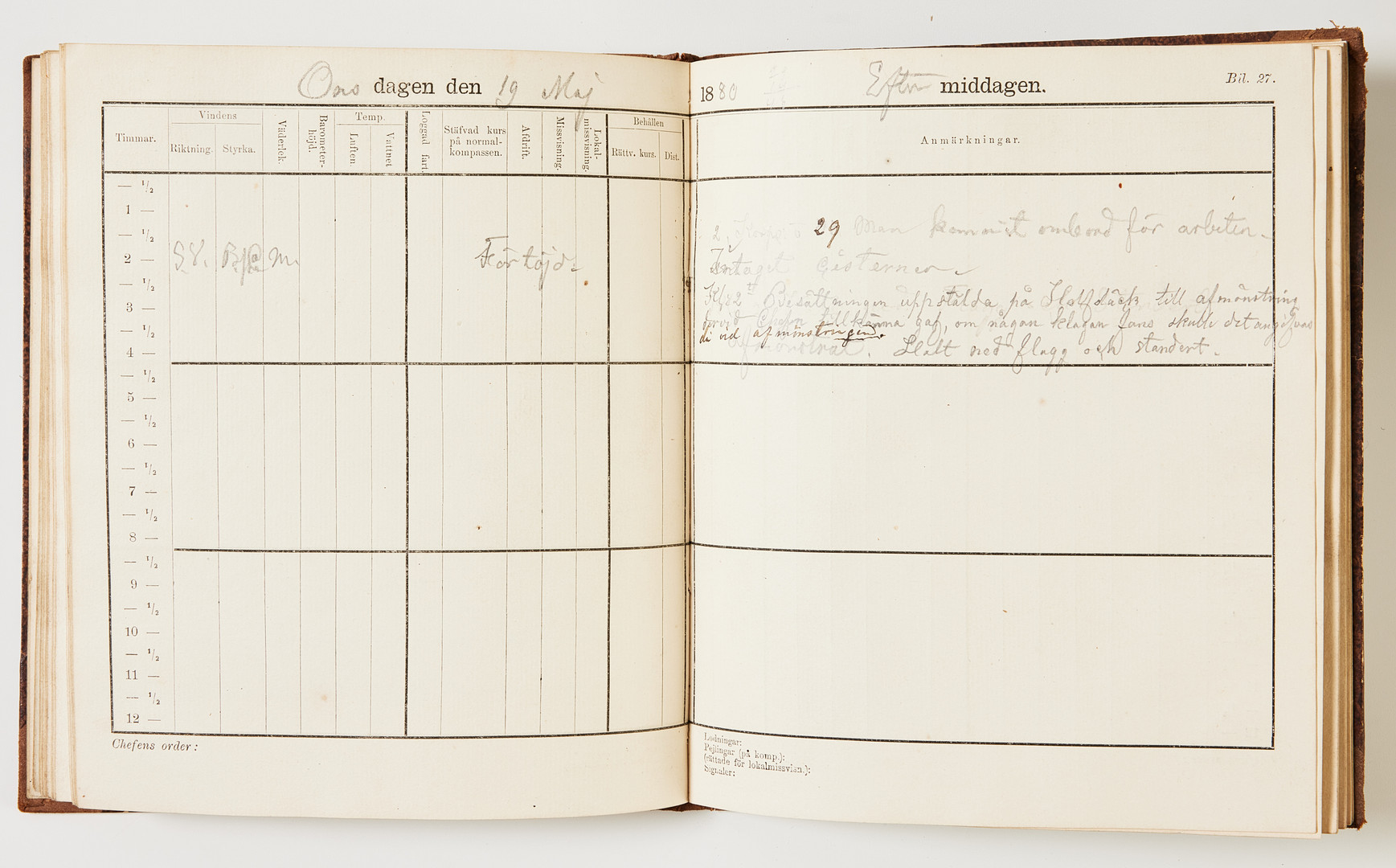
After a week of work in Karlskrona, the crew is finally able to pattern off on May 19. Palander notes “Halt ned flag och standert” and after that the volume is empty.
See catalog text.
