Prinsessa by John Bauer
John Bauer is one of Sweden’s most beloved fairy-tale artists, and two recurring motifs stand out in his visual world in particular: the delicate princesses and the trolls. As early as the turn of the twentieth century, his naturalistic forest landscapes began to populate with fantastical creatures. The trolls evolved from simple, rounded stone-like forms into increasingly grotesque and distorted figures with angular bodies and large noses. Their power and significance in Bauer’s art lie in their close affinity with the forest, where they seem almost to emerge from nature itself.
Against this dark and enchanted backdrop, the princess appears as a striking contrast. She is luminous, clear, and often ethereal in expression, like an unfamiliar figure in the shadowy corners of the forest. In many scenes she has been abducted by trolls or lost on the fringes of the kingdom, reinforcing a sense of vulnerability, but also of fairy-tale beauty. Much of the inspiration for Bauer’s princesses came from his wife and fellow artist Ester Ellqvist, who became both model and muse. Her features can often be discerned in the bright, serene, and contemplative princesses that inhabit his imagery. Ellqvist’s presence helped lend these figures a human intimacy and psychological depth, so that they appear not merely as fairy-tale beings, but as individuals with an inner life. Her elegant posture and expressive gaze seem to have influenced the way Bauer depicted his female figures, in whom fragility and strength coexist.
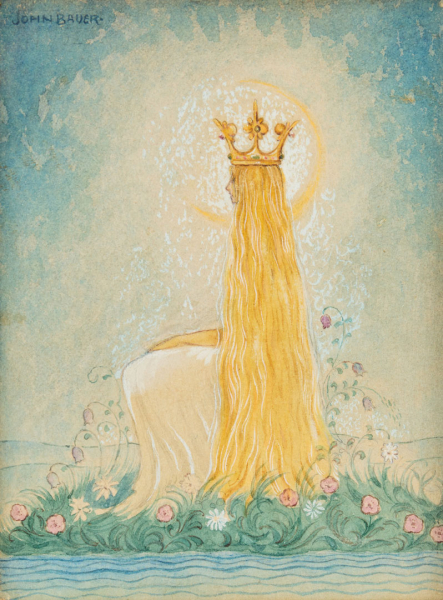
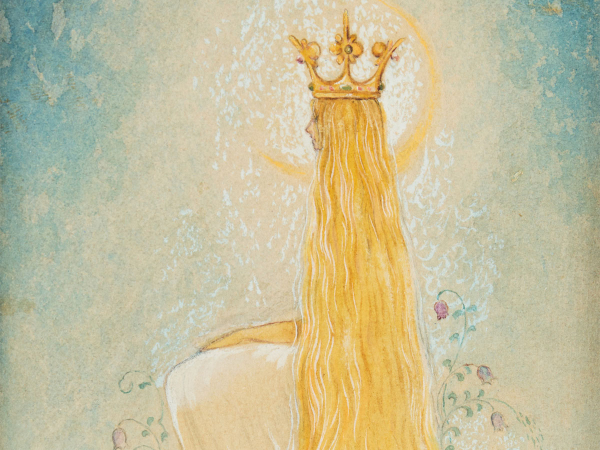
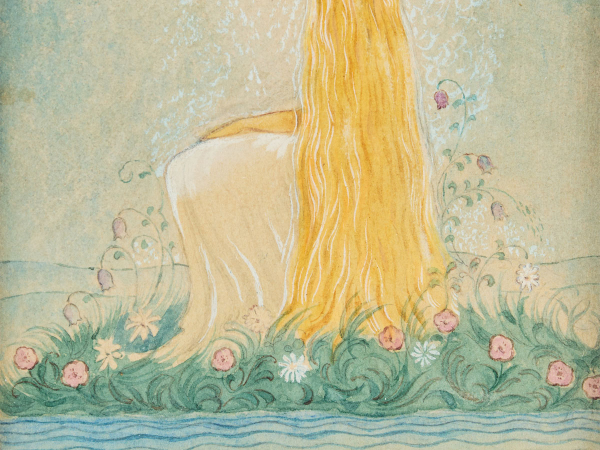
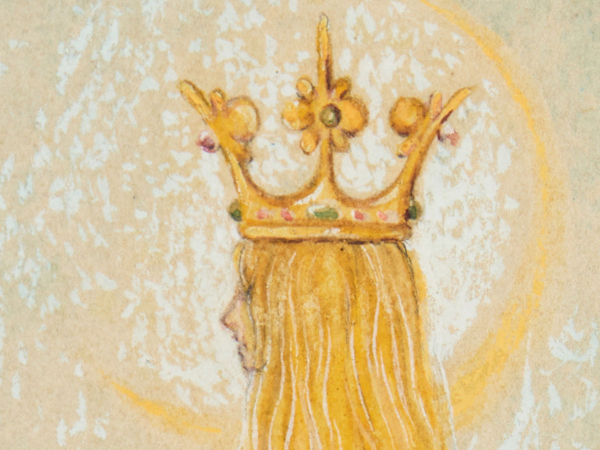
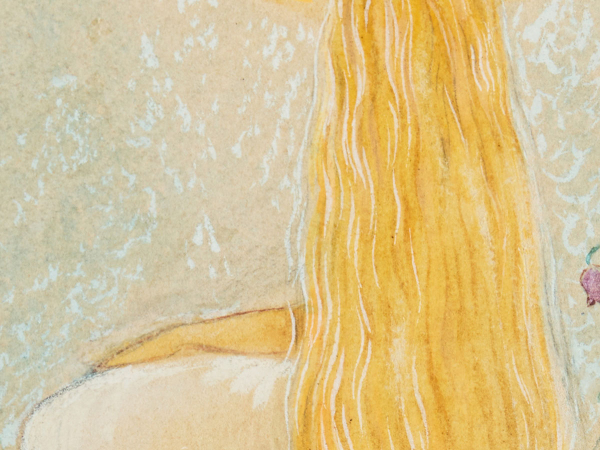
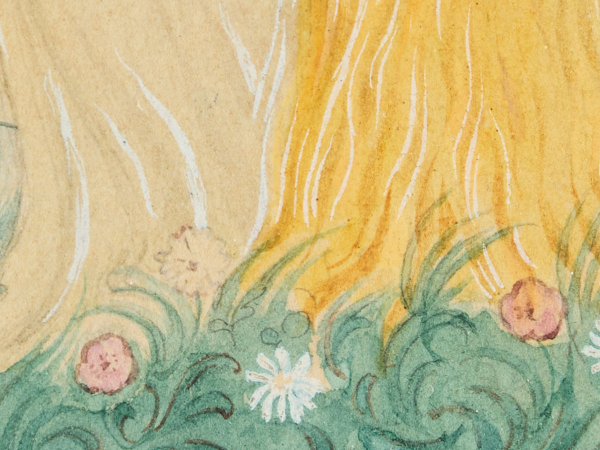
In the present work, “Prinsessa” (“Princess”), we encounter a young princess crowned with a magnificent tiara resting above her long golden hair. She sits surrounded by flowers that entwine and envelop the hem of her gown, forming a floral throne. Beneath the princess and her throne flows water — perhaps a magical spring? The viewer cannot fail to notice the heavenly light and shimmering texture that surround the princess. When Bauer and Ellqvist travelled to Italy on their honeymoon, Renaissance art became a major source of inspiration, and “Prinsessa” possesses something of a Renaissance Madonna in the way she is depicted in profile. Rather than placing a golden halo around her, Bauer instead explored the versatility of watercolour.
“Prinsessa” is an undated work, but it displays many similarities to the 1915 lithograph “Prinsessan och småtrollen” (“The Princess and the Little Trolls”), in which the composition has been simplified. The image may possibly have been inspired by the tale “Pojken och trollen eller Äventyret” (“The Boy and the Trolls, or The Adventure”) by Walter Stenström, published in the well-known collection Bland Tomtar och Troll.
It was precisely as an illustrator for Bland Tomtar och Troll, first published in 1907, that Bauer achieved his major breakthrough. During the years 1907–1910 and 1912–1915, he developed his characteristic style, in which moss-covered stones, deep forests, shimmering princesses, and lumbering trolls combine to form a unique fairy-tale world. Bauer’s art also emerged during a time of change. In the early twentieth century, new printing technologies made literature and illustration accessible to a broader audience, not only to children of the upper and middle classes. At the same time, Sweden was shaped by the ideals of National Romanticism, which are reflected in Bauer’s imagery. His pictures captured both the mystery of nature and the magic of fairy tales, and within this context the princess became a symbol of light and fragility — a contrast that brought life to his enchanted universe.
John Bauer (Sweden 1882–1918) Prinsessa (“Princess”)
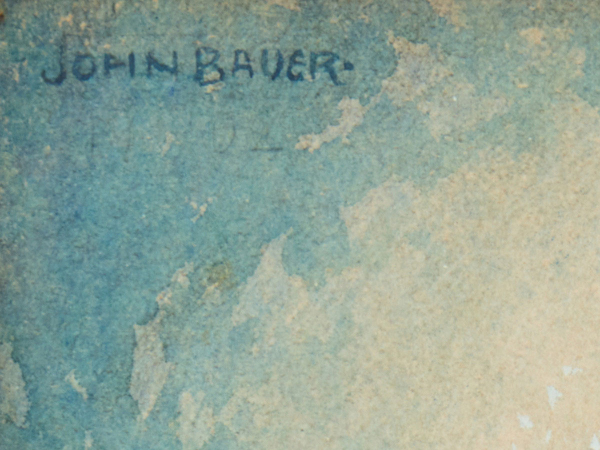
Watercolour and bodycolour on paper, 15 x 12 cm; including frame 37 x 32 cm. Signed John Bauer.
Compare with the motif in the lithograph “Prinsessan och småtrollen” (“The Princess and the Little Trolls”) from the series “Troll” (1915), as well as with the princess depicted on the cover of Bland Tomtar och Troll, 1915.
PROVENANCE
Private collection, Sweden
EXHIBITIONS
Prins Eugens Waldemarsudde, Stockholm, “Trollbunden – John Bauer och den magiska naturen” (“Spellbound – John Bauer and the Magical Nature”), 5 September 2020–23 May 2021, cat. no. 63.
LITERATURE
Karin Sidén and Carina Rech (eds.), Trollbunden – John Bauer och den magiska naturen, 2020, illustrated p. 105 and listed under cat. no. 63.
ESTIMATE
SEK 1,000,000–1,200,000
Viewing: May 29–June 8, Nybrogatan 32, Stockholm
Live auction: June 10
Read more about The Curated Classics Sale here ›
More works by John Bauer at The Curated Classics Sale
Enquiries & condition reports


Victoria Svederberg
Expertin – Fine Art

Unsere Tätigkeit