“Badscen (Badstranden och skuggan)” (“Bathing Scene (The Beach and the Shadow)”) from 1918 by Sigrid Hjertén
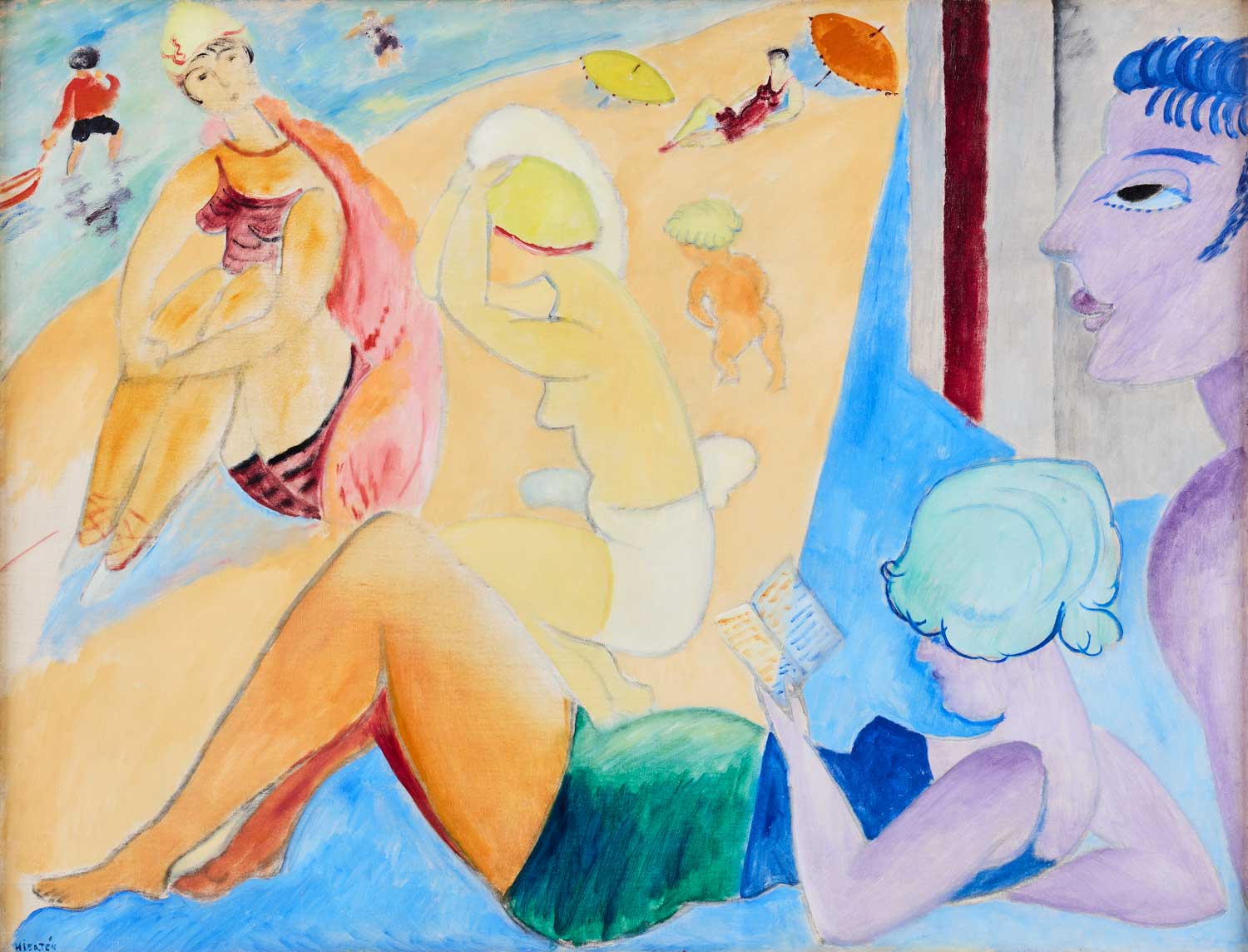
Sigrid Hjertén’s “Badscen (Badstranden och skuggan)” (“Bathing Scene (The Beach and the Shadow)”) was painted in 1918, the same year as the Expressionist Exhibition at Liljevalchs Konsthall. The motif is drawn from beach life on the Danish coast, depicting her husband Isaac Grünewald, his sister Berthe and their son Iván in a composition divided by light and shadow. The painting has been in the same private collection since 1994.
1918 was a highly significant year for Sigrid Hjertén and her husband Isaac Grünewald. That year, together with Leander Engström, they exhibited at the groundbreaking Expressionist Exhibition at Liljevalchs konsthall in Stockholm, which came to be associated with the breakthrough of modernism in Sweden. The exhibition was both lavishly praised and fiercely criticised in the press, but it left no one indifferent. Hjertén in particular was harshly attacked by the art critics of the day, who dismissively claimed that she lacked independence and was a pale copy of her husband. It was not until the 1980s that her work began to be recognised on its own merits.
Nearly ninety years later, in 2008–2009, Liljevalchs looked back with the exhibition “Den stora färgskrällen”, featuring the same three artists: Isaac Grünewald, Leander Engström and Sigrid Hjertén. In the exhibition catalogue (p. 47), curator Anders Wahlgren wrote:
“Today we know how much the exhibition at Liljevalchs did to introduce modern art to a wider Swedish audience, even though many visitors at the time were conservative and critical. All three artists carried on with their personal and radical approach to painting, and at this time they were beginning to reach an ever larger public in Sweden. Isaac, Leander and Sigrid still feel modern, even though several of their works were painted almost a hundred years ago. These three modernists not only brought a new way of approaching the artistic image, but were also important figures in promoting a greater understanding of personal conviction. They fought for the right to express themselves on their own terms. The years around the 1918 exhibition at Liljevalchs also represent a high point in the artists’ production.”
During the First World War (1914–1918), Copenhagen played a decisive role as the “Paris of the North” for the Nordic modern avant-garde. Denmark remained neutral, while its borders to continental Europe were closed, and so the Danish capital became a vital refuge, marketplace and melting pot for artists who had sought to travel as far south as they could.
Isaac and Sigrid also spent a great deal of time in Copenhagen during these years. In the summers they enjoyed the seaside life on the long sandy beaches, and Fanø, off Denmark’s west coast, was a popular resort and a recurring motif in the couple’s paintings from this period. In 1917, Sigrid painted “Figurer på badstrand” (“Figures on a Beach”, in the collections of Göteborgs konstmuseum) at the beach on Fanø, showing sunbathing couples and playing children. The work is painted in a heightened palette and a diagonal composition, in which a yellow central section is surrounded by more subdued fields of colour. It is interesting to compare this work with “Badscen (Badstranden och skuggan)”, the painting offered here, executed the following year. In the later work, Sigrid has let herself go and ventures out in an independent and daring manner. Her handling of colour becomes even more uncompromising, and this year she also reaches new artistic heights.
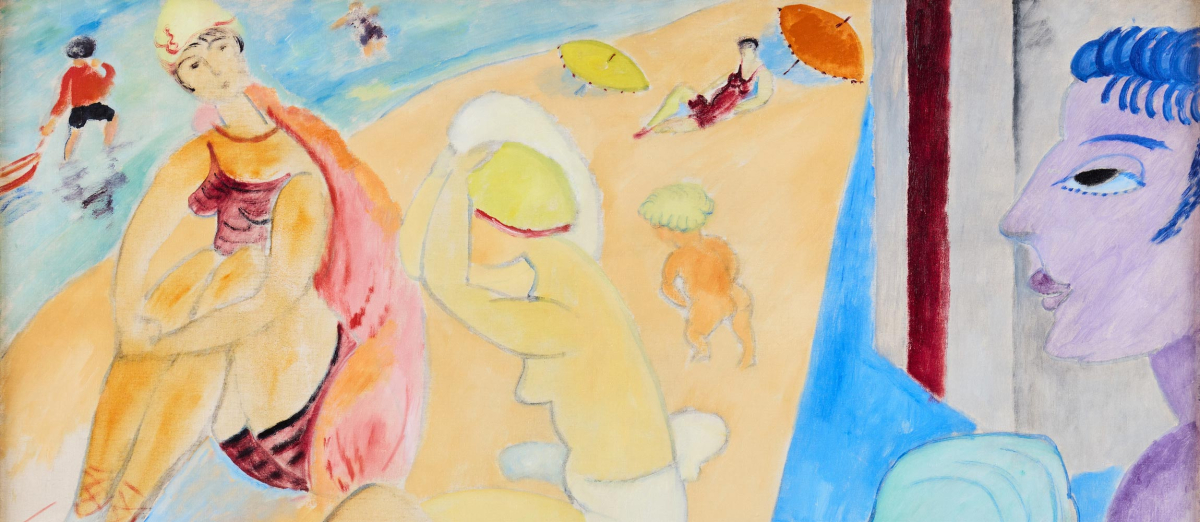
In “Badscen”, she stages the motif dramatically, lighting the left side as if by a spotlight shining across the bathers in steep diagonals that cut through the picture. The colours here are warm, dominated by yellows with contrasting energetic patches of red, while the right side lies in shadow, painted in cool blue tones that make the red details there appear in an entirely different light. We see Isaac in profile and, in front of him, his sister Berthe reading a book. As so often in Sigrid’s paintings, their son Iván is present, this time at the water’s edge with his sailboat. Sigrid Hjertén had a unique feeling for colour and nuance, and like no one else she could set colours against each other so that the whole work comes to life.
Many of Sigrid Hjertén’s paintings from this year and of this quality now hang in museums and institutions. “Badscen (Badstranden och skuggan)” has remained in the same private collection since it was last sold in 1994.
DESCRIPTION
Oil on canvas, 90 x 116 cm, including frame 109 x 135 cm. Signed HJERTÉN. Executed in 1918.
PROVENANCE
Nordén Auktioner, October 1994, lot no. 11.
Swedish private collection, acquired at the above auction.
EXHIBITED
Liljevalchs Konsthall, Stockholm, “Expressionistutställning” (“Expressionist Exhibition”), 1918, cat. no. 359.
Liljevalchs Konsthall, Stockholm, “Sigrid Hjertén”, March 17–May 28, 1995, cat. no. 44.
Liljevalchs Konsthall, Stockholm, “Den stora färgskrällen” (“The Great Burst of Colour”), September 12, 2008 – January 6, 2009, cat. no. 165.
LITERATURE
Exhibition catalogue, Liljevalchs Konsthall, “Sigrid Hjertén”, 1995, illustrated under cat. no. 44.
Anders Wahlgren, “Sigrid Hjertén – en av Sveriges främsta konstnärer” (“Sigrid Hjertén – One of Sweden’s Foremost Artists”), 2008, illustrated p. 106.
Liljevalchs Konsthall, Stockholm, “Den stora färgskrällen” (“The Great Burst of Colour”), September 12, 2008 – January 6, 2009, cat. no. 165, illustrated full page in colour.
Viewing
November 6–16
Nybrogatan 32, Stockholm
Opening hours
Monday–Friday 10am–6pm
Saturday–Sunday 11am–4pm
Live auction
November 18
Nybrogatan 32, Stockholm
Enquiries & condition reports

Knut Knutson
Head specialist

Andreas Rydén
Deputy CEO and Head Specialist

Lena Rydén
Director Fine Art
Currently

More on us