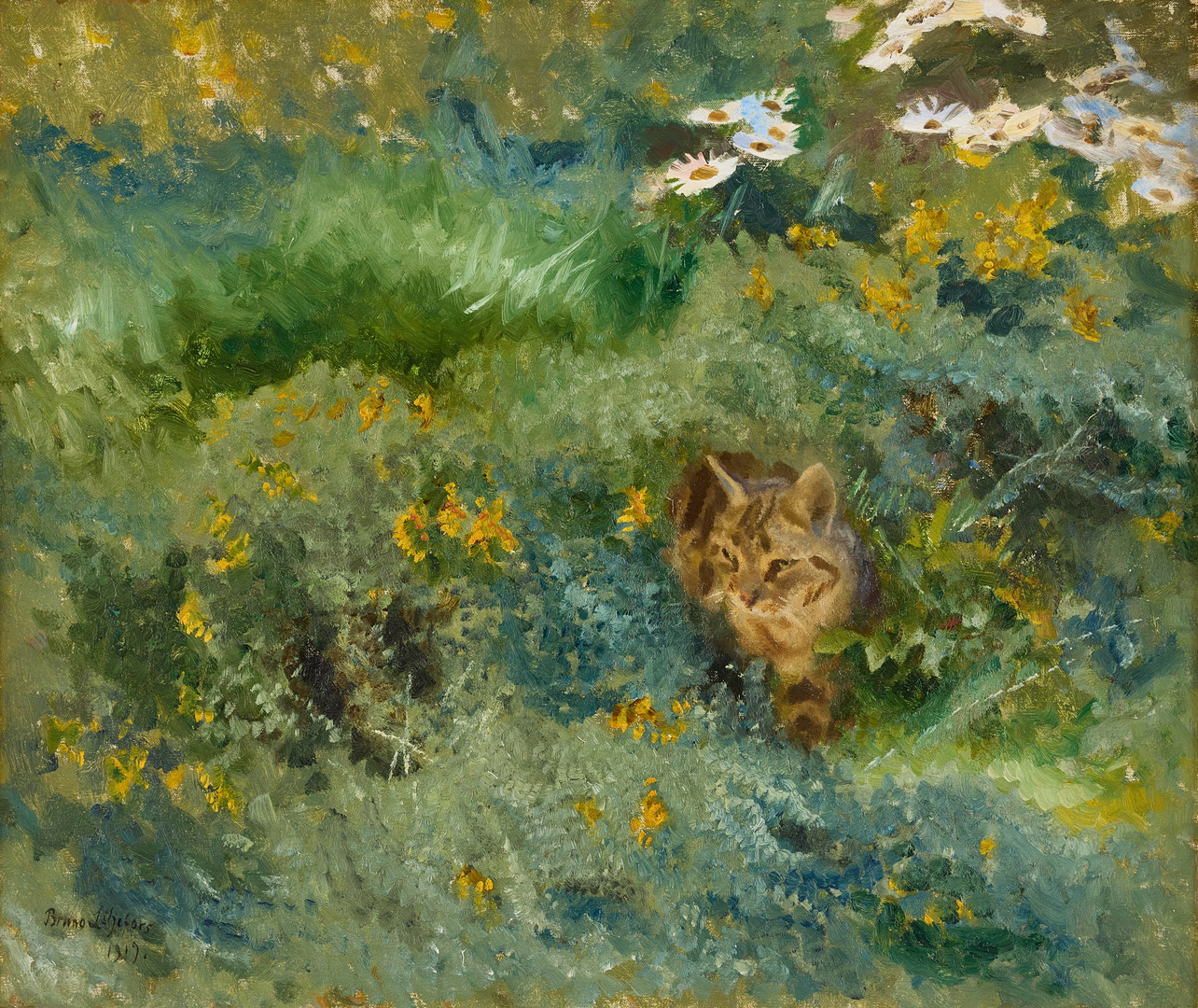
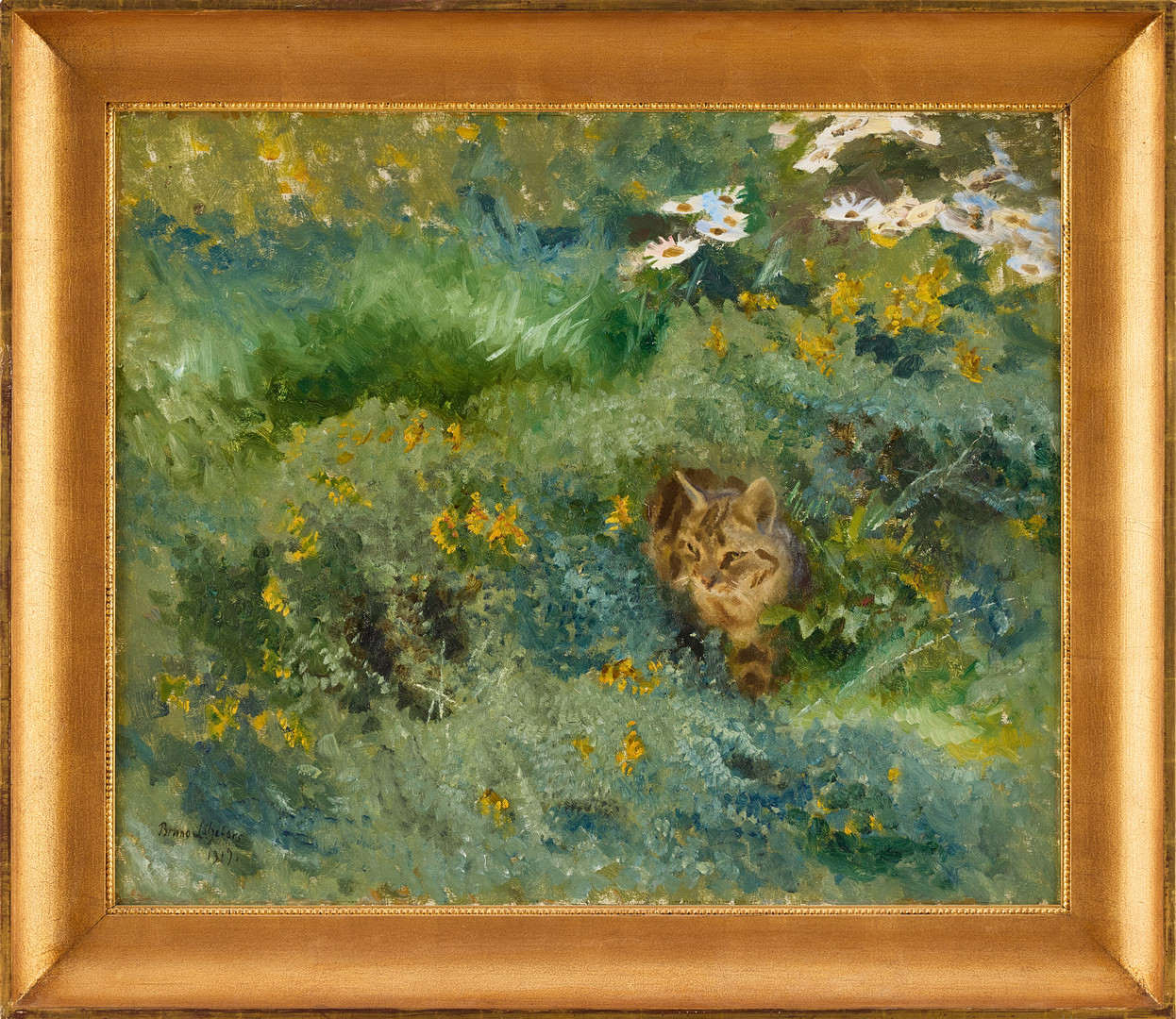
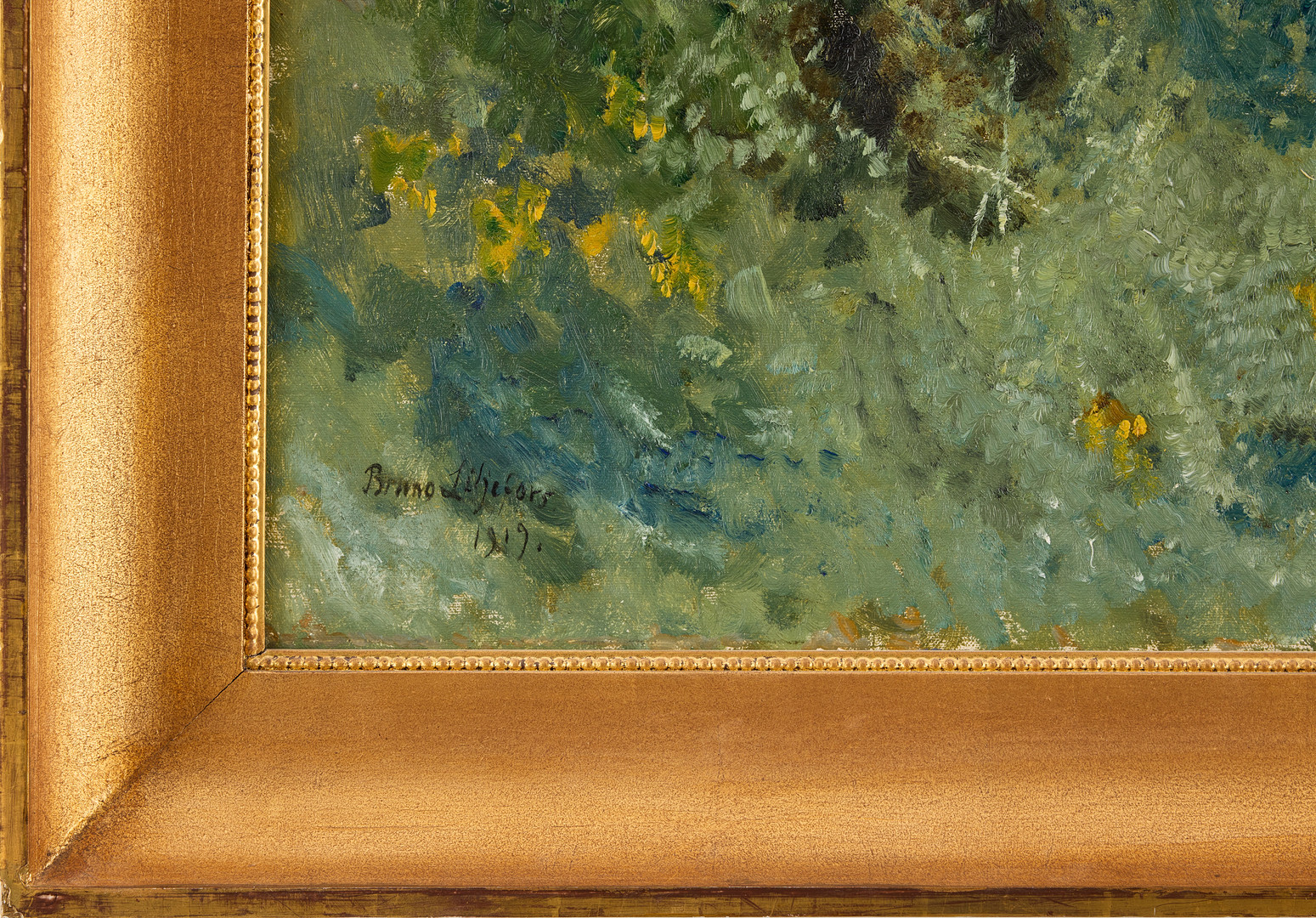
Oil on canvas, 76 x 91 cm, including frame 100 x 110 cm. Signed and dated Bruno Liljefors 1919.
PROVENANCE
Purchased directly from the artist, thereafter in private ownership.
Bukowskis, Stockholm, 27 May 2008, lot 142.
Åmells konsthandel, Stockholm.
Swedish private collection.
LITERATURE
Bo Lindwall and Lindorm Liljefors, Bruno Liljefors, 1960, illustrated p. 139.
Bruno Liljefors did not paint people, he painted animals. He painted the animals with a very special feeling, knowledge, and honesty. He let their innermost essence speak and he portrayed them in their own home. No other Swedish artist, either before or since, has come close to being able to paint animals as Liljefors could. The cat was probably the animal that Bruno Liljefors identified with the most. As a young boy, he had been sickly, small, and frail. He often sat drawing, pondering, and studying various animals in his vicinity. He was impressed by the anatomy of cats, and they became his physical ideal. Thus, he began to train his own body and constantly walked in nature; over time, he became a true athlete. Liljefors understood that in order to depict animals in the right way, in their own environment and proper context, he had to approach them on their own terms. As an observer, he became like the animal itself, slowly sneaking under the branches of the forest, crawling over logs and stones, and lying for a long time in the reeds waiting for the right moment. It is also this perspective he uses in his compositions, which become bold slices of reality. When Liljefors returned to his homeland from France during the late 1880s, he settled in Kvarnbo outside Uppsala, where he mainly found his motifs for the finely tuned depictions of the early decades. It was also now that the cat Jeppe came into his life, and the artist tells of their first meeting in "Det vildas rike":
"I once came home as a young man from the hunt with a capercaillie hen that I had shot. I was boarding in a farmhouse. A small kitten was playing on the floor where I threw the capercaillie hen. At first, he ran like lightning under the bed but was out again shortly after, walked carefully forward, and then resolutely grabbed the neck of the bird and dragged the heavy prey backwards with him under the bed. The kitten was just the type I liked, earth-grey with darker cross-stripes and no white. When I moved, I received the cat as a gift, and we became inseparable thereafter."
The cat Jeppe then became not only Bruno Liljefors' cat but also his best friend. Several of Liljefors' foremost works are depictions of Jeppe's everyday adventures in the Uppland nature, and Liljefors soon developed into one of his time's most promising and innovative artists who lifted Swedish painting to new heights, one of the foremost interpreters of plein air painting. Liljefors made it his life's work to depict our Swedish flora and fauna in the most initiated and sincere way. He became one with nature, lived and worked close, as close as a human can. With his quick brushwork, he captured and immortalized astonishing scenes with a superb wealth of detail. The cat Jeppe became his devoted friend and constant shadow: "He followed me in the forest like a dog. He would make joyful leaps around me when I took the gun from the wall. When he felt lazy, he used to take a nimble leap onto my shoulder – even when I was in full march – and lay around my neck on my shoulders. At night, he lay on the quilt at my feet and would occasionally come purring and rub against my neck to confirm that everything was all right. When I sometimes went away, he used to meet me a couple of kilometers from home upon my return and accompany me."
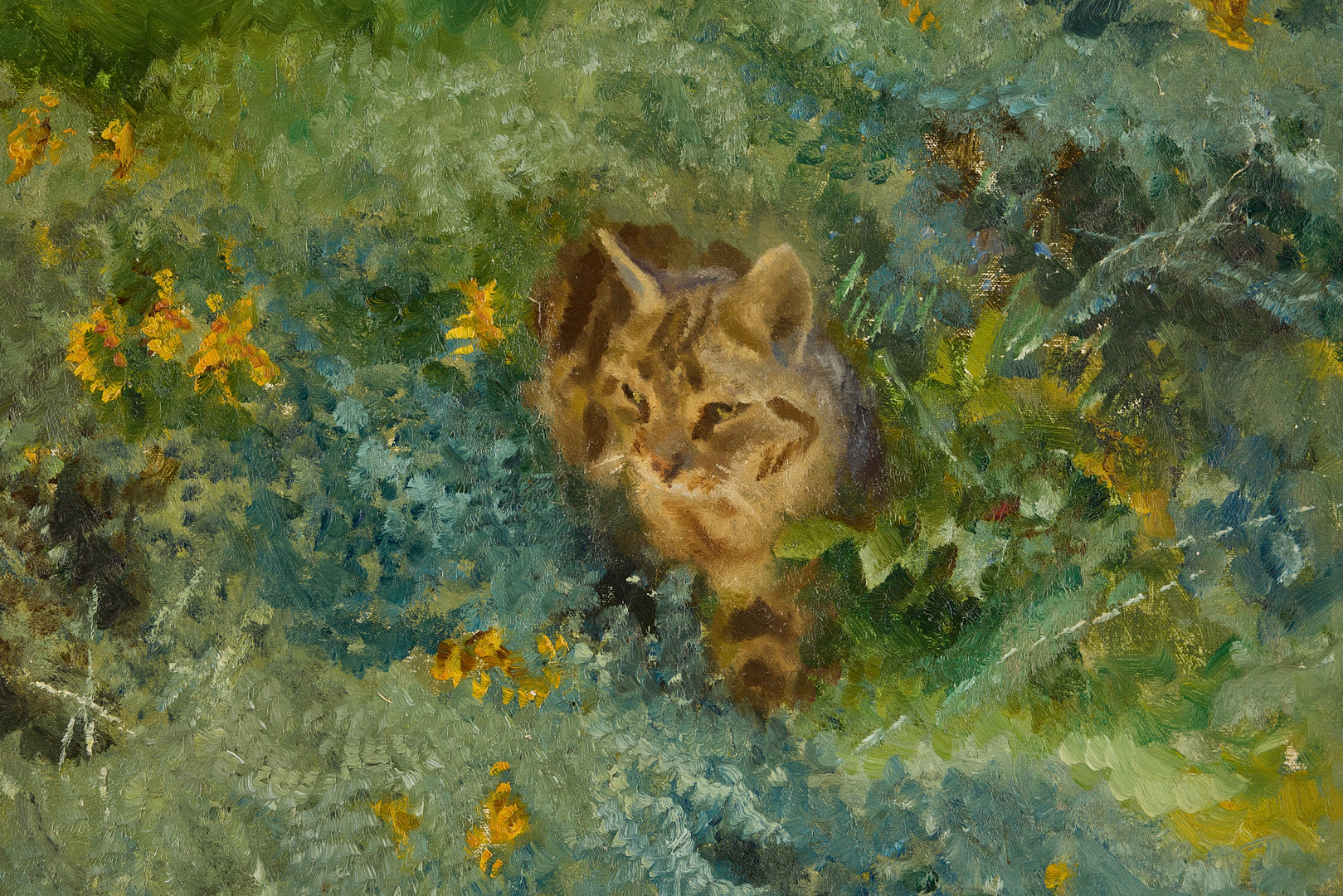
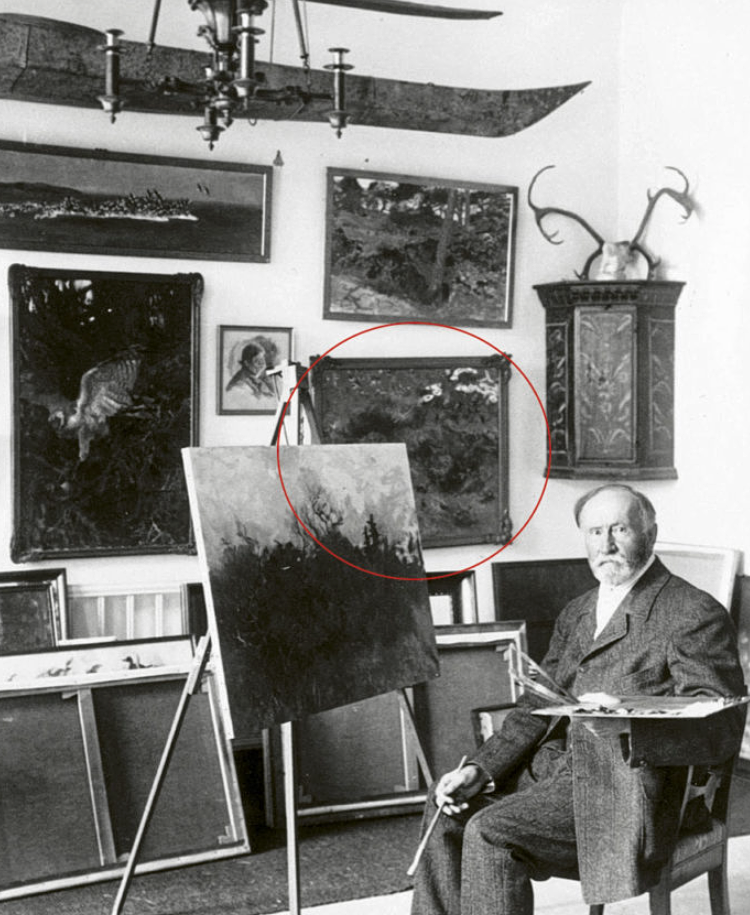
The cat in the wonderfully lush flower meadow in the auction's painting shows great similarities to Jeppe, although it is uncertain if it is indeed him portrayed here, as the painting is dated 1919. Perhaps it is a new, similar cat that had come into Liljefors' life, or perhaps it is a lovely memory of the good friend who forever meant so much to him. For Liljefors, it was naturally a great loss when Jeppe left this life; he shared his feelings with his good friend Zorn: "Imagine that my beautiful model 'Jeppe', the cat, whom I loved even more than the fox cubs, fell ill and died for me just now. I truly mourn the noble animal. It was no ordinary cat, you must believe. Half again as large as an ordinary cat, athletic – the musculature, especially on the shoulders, shimmered through the fur – but such an honorable cat, you must believe!". It is clear, regardless, that the auction's painting was of great importance to Liljefors himself, as it hung next to him in his studio, placed right next to the easel at eye level. Sneaking through the tall grass, the cat moves forward; perhaps it has spotted some small bird, mouse, or vole, the gaze is purposefully searching. It is sweet summer, and the meadow has been filled with flowers of brilliant yellow bird's-foot trefoil and oxeye daisies, and the idyll seems perfect. But naturally, the cat is always ready – lurking for suitable prey and lightning-fast to strike whenever the happy opportunity presents itself.