“Apachedansen” (“The Apache Dance”) by Isaac Grünewald
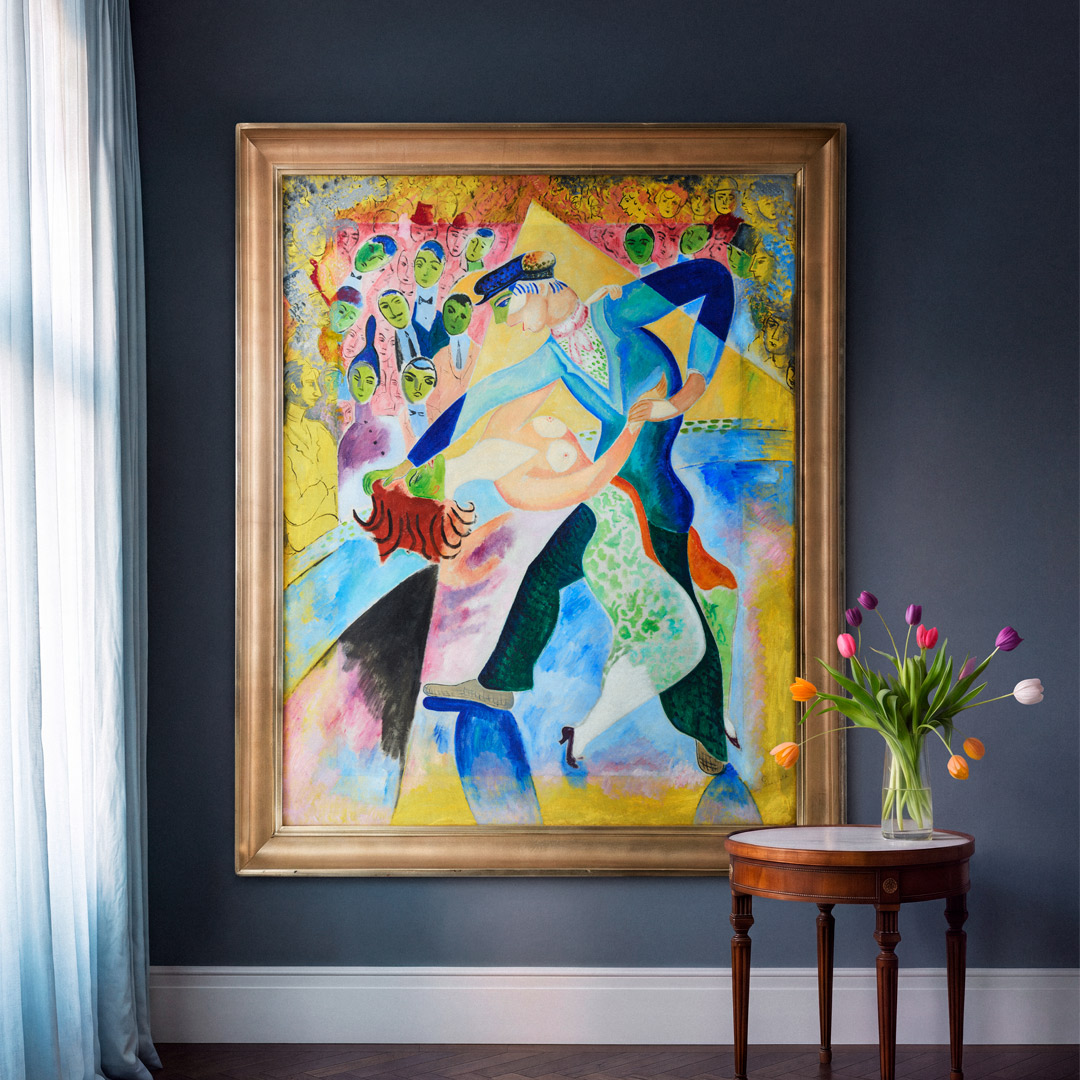
Spotlights, red, blue and yellow, and a dancing couple in violent motion. In “Apachedansen” from 1918, Isaac Grünewald depicts the nightlife of Paris. The same year, the painting was shown at the Expressionist Exhibition at Liljevalchs, a milestone in the breakthrough of modernism in Sweden.
Isaac Grünewald lived through and through as a modern person in the new era of the early 20th century. He was a colourful figurehead who resisted outdated ideas and norms. Instead of the traditional art academy, he chose freer studies under Henri Matisse in Paris, where he embraced the Fauvist and Expressionist ideas of the freedom not to paint representationally, but instead to convey the artist’s feelings through colour and form. But it was not only through art that Grünewald absorbed these new ideas. During his first years in Paris, around 1908–1911, he and his future wife Sigrid Hjertén found themselves in a cultural melting pot where pioneering modernism permeated not only art but also literature, theatre, music and dance.
The Apache dance emerged in Paris around the turn of the century in 1900, born of the subculture surrounding the city’s criminal youth gangs, known as Apaches. The dancing couples symbolised the dramatic interplay between a man and a woman, in a violent and acrobatic dance that included simulated slaps, hair-pulling and physically demanding throws. In 1908, the dance moved from the shady taverns onto the famous stage of the Moulin Rouge, before spreading further through cabarets and silent film. From there, it was not a long step before the avant-garde artists of Paris took up the motif in their art as a symbol of raw, modern city life.
The couple Grünewald-Hjertén brought these influences with them when they moved back to Sweden in connection with the birth of their son Iván in 1911. They came to play an important role as leading stars of modernism and introduced Expressionist art theory, French fashion and modern dance to Stockholm. The film “Är dansen på förfall” (“Is Dancing in Decline?”) was shown in Swedish cinemas in 1915 as a contribution to the moral debate against modern dance at the time. Grünewald, who attended the premiere, whistled in protest because he felt the modern dances were performed incorrectly, which led to him being commissioned to make a new, correct version.
In the follow-up film, shown at the Brunkebergsteatern the same year, he dances with Sigrid. Even though they did not perform the daring and violent Apache dance, but the far more modest one-step and Boston, the film was banned for children on the grounds that it was “liable to excite children’s imagination harmfully”. The film was at times harshly criticised and was called, among other things, “the Grünewald mating dance”. Grünewald defended himself and the film in the press, writing that the Swedes suffered from an “inability to grasp anything that comes from a somewhat higher temperature than their own”.
Artistically, too, Grünewald challenged the art establishment during this period. In the mid-1910s, when artists such as Anders Zorn, Bruno Liljefors and Carl Larsson dominated, modern Expressionist art provoked strong reactions from both the public and the critics. It was not until the major Expressionist Exhibition at Liljevalchs in Stockholm in 1918 that modernism could be said to be established on the Swedish art scene.
In 1917–1918, Grünewald painted a suite of three paintings regarded as one of the high points of his artistic oeuvre: “Tjurfäktning” (“Bullfight”, Norrköping Art Museum), “Cirkus” (“Circus”, private collection) and “Apachedansen”. All three later hung together in the dining room of Grünewald’s private home in Saltsjöbaden, where he moved in 1937. “In terms of subject matter, the paintings from this period are very different from one another. Some of the motifs revolve around circuses, Apaches, bullfights, café and restaurant interiors, theatre. In them we meet a certain opposition to the bourgeois ideal of society. He who has never wanted to run away with a circus, never experienced five o’clock tea as a release from the banality of everyday life, he who has never in his dreams fought with Apaches or stabbed a bull with all eyes upon him, he who has never wanted to bring a fallen girl back to the right path, he who has not loved the dust of the stage and the bohemian’s garret, horror ballads and chansons, has never been young.” J.P. Hodin, “Isaac Grünewald”, Stockholm, 1949, pp. 89–90.
All three motifs are set on some kind of stage, brightly lit by spotlights that divide the paintings into dramatic diagonals. Grünewald was fascinated by the possibilities that electric lighting offered for the development of modern art. In connection with the major Expressionist Exhibition, Grünewald gave a lecture in April 1918 to the Aesthetic Society in Uppsala on “The New Renaissance in Art”, in which he discussed, among other things, the importance of electric light.
“I take this opportunity to say a few words about modern technique. Manet himself said: ‘The flatter, the more artistic – let us make playing cards.’ /…/ One can, for example, work with yellow light, such as sunlight, blue light such as daylight, spotlighting with green, red or blue light, and so on. The shadows then always contrast with the colour of the light.”
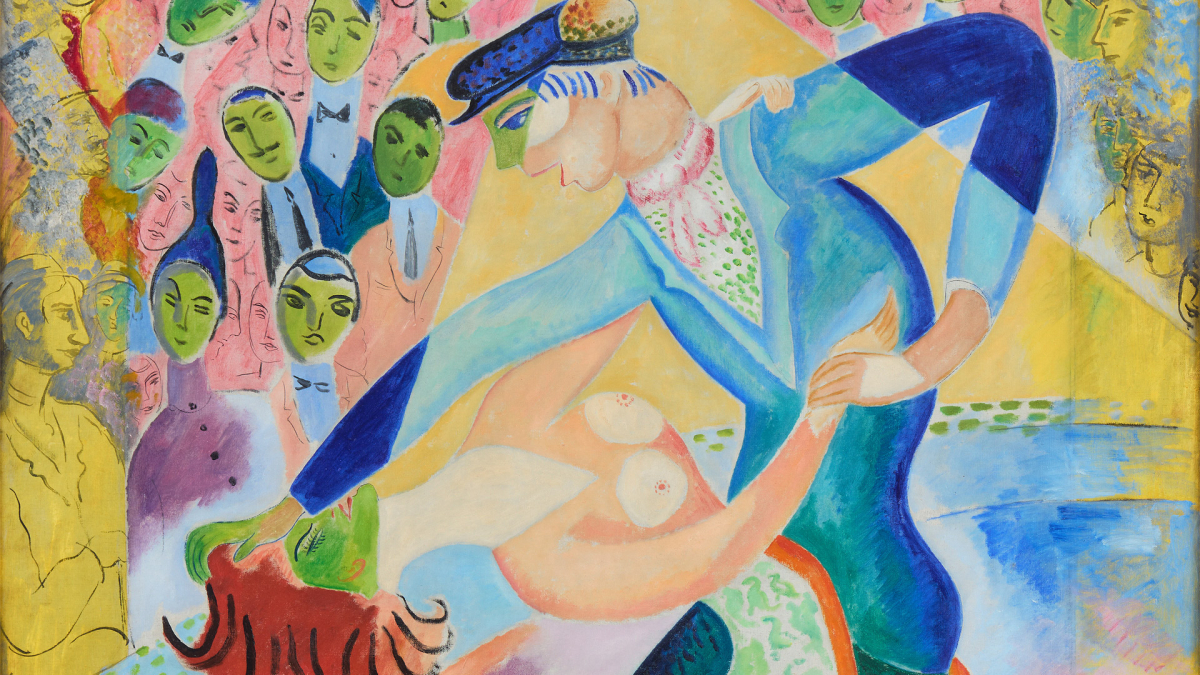
In “Apachedansen”, the dancing couple is at the centre in a daring pose in which the man dramatically pushes his partner’s head away. The woman, boldly bare-breasted, presses herself against the man, tightly entwined around one of his legs. The palette is pushed to the limit with red, blue and yellow, which in turn make the whole painting vibrate with inner energy. The steep diagonals of the spotlights cut through the entire picture but are broken by the soft S-curves of the bodies, together creating intense movement and dynamism. The faces of the woman and the audience, just outside the beam of light, are boldly painted in green, while the rest of the audience is almost abstracted, merely suggested by a simple outline.
The reproduction of “reality” is no longer the task of art, Grünewald emphasises: “The artists of our time seek a higher reality than the visual.” The Impressionists still rendered nature as they saw it; the Expressionists, by contrast, create a synthesis of what they have seen. /…/ The distance in time between the experience and the painting is important, Grünewald stresses – the Impressionist paints immediately what he sees, everything is included, large and small; the Expressionist is a painter of memory, he has suppressed everything inessential, he has only “the essential clear in his memory”. Per Gedin, “Isaac Grünewald – modernist och människa”, 2015, pp. 184–185.
“Apachedansen” is regarded as one of the most important key works of modernism, paving the way for an entirely new direction in Swedish art history and fundamentally changing the way we see art.
The work goes under the hammer on 9 December at The Curated Classics Sale Timeless Masters. The estimate is SEK 15–20 million.
Description
Oil on canvas, 170 x 132 cm, including frame 192 x 153 cm. Signed twice Isaac Grünewald and Isaac G. Executed in 1918.
PROVENANCE
Swedish private collection.
Bukowskis, Stockholm, April 24, 1997, lot 176.
Bukowskis, Stockholm, November 6, 2001, lot 120.
An important Swedish private collection, acquired at the above sale.
EXHIBITED
Liljevalchs Konsthall, “Expressionistutställningen” (The Expressionist Exhibition), 1918, cat. no. 68.
Galerie Licorne, Paris, 1921, cat. no. 21 (the artist’s first solo exhibition).
Liljevalchs Konsthall, “Isaac Grünewald Målningar 1904–1944”, 1944, cat. no. 131.
Liljevalchs Konsthall, “Jubileumsutställning 1909-års män”, 1959, cat. no. 57.
Liljevalchs Konsthall, “Det sjungande trädet”, September 8–November 5, 1989, cat. no. 79.
Norrköpings Konstmuseum, “Det sjungande trädet”, November 19, 1989–January 28, 1990.
Borås Konstmuseum, “Det sjungande trädet”, February 11–April 8, 1990.
Judiska museet, “Isaac Grünewald konstnären, scenografen och människan”, Stockholm, 2000–2001.
Liljevalchs Konsthall, “Den stora färgskrällen”, October 4, 2008–January 6, 2009.
LITERATURE
J.P. Hodin, “Isaac Grünewald”, Stockholm, 1949, mentioned pp. 89–90.
Karl Axel Arvidsson, Veckojournalen, 1959, no. 19–20.
Exhibition catalogue, Liljevalchs Konsthall, “Den stora färgskrällen”, October 4, 2008–January 6, 2009, illustrated full page in colour, fig. 11.
Bernhard Grünewald, “Orientalen – bilden av Isaac Grünewald i svensk press 1909–1946”, Stockholm, 2011, illustrated p. 98.
Per Gedin, “Isaac Grünewald – modernist och människa”, 2015, illustrated full page p. 179.
Catalogue publication
November 25
Viewing
November 27–December 6
Nybrogatan 32, Stockholm, Sweden
Opening hours
Monday–Friday 10am–6pm
Saturday–Sunday 11am–4pm
Live auction
December 8–9
Nybrogatan 32, Stockholm, Sweden
Enquiries & condition reports

Knut Knutson
Head specialist

Andreas Rydén
Deputy CEO and Head Specialist

Lena Rydén
Director Fine Art
Currently
More on us