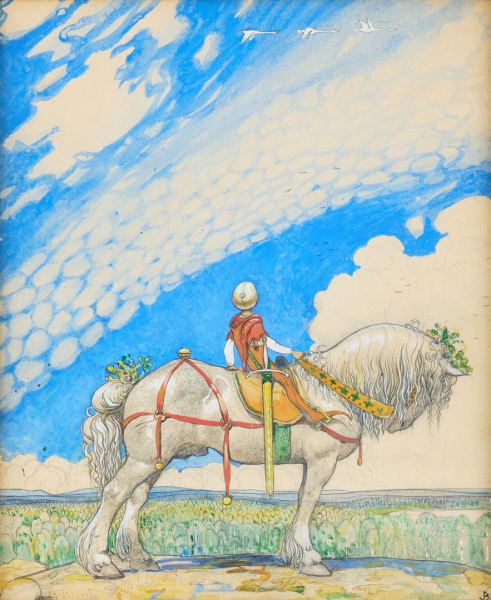
”Ut i vida världen” by John Bauer
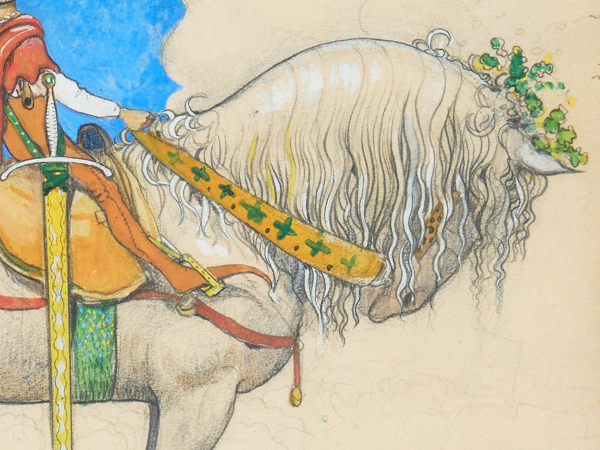
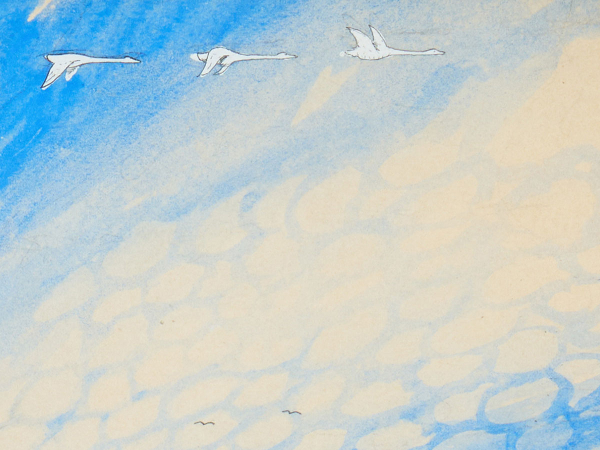
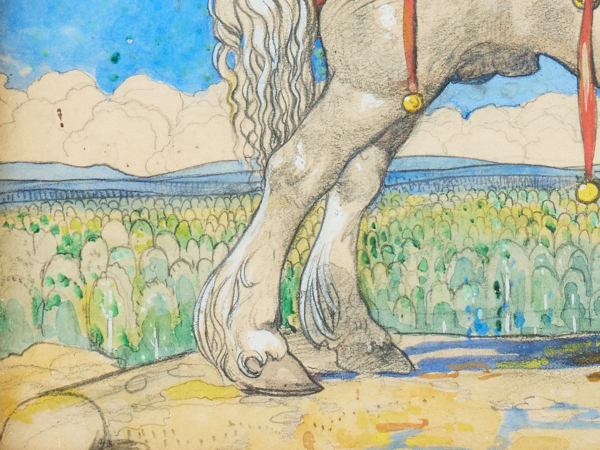
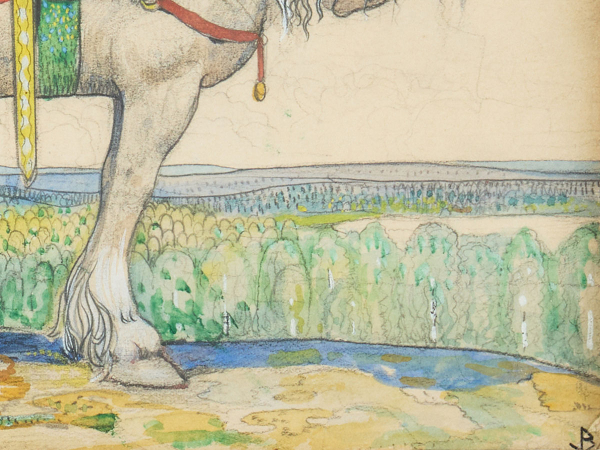
“Christmas magazine for big and small children” — so reads the cover of “Julbocken”, first published in 1907. It was in this publication that “Ut i vida världen” (“Out into the Wide World”) appeared as a plate illustration. In this watercolour we encounter a motif that captures the feeling of longing, adventure, and standing before the unknown. The painting depicts a young figure, perhaps a knight in the making, seated upon a large and magnificent white horse. The two stand on an elevated place — a mountain or cliff — gazing out across the landscape below. Yet the boy’s gaze is directed not downward, but upward towards the three swans flying overhead. Could this be a foreshadowing of future events? Within Nordic and Sámi traditions, the swan has often been associated with inner and spiritual wisdom. During the same period, Bauer was also approached by Albert Bonniers Förlag to illustrate Nils Holgerssons underbara resa, where the goose Akka may perhaps have inspired the birds in “Ut i vida världen”.
“Ut i vida världen” has been reproduced countless times and is an image with strong recognisability. Many may assume that it was included in Bland Tomtar och Troll, but it is in fact an example of an earlier collaboration between the publisher Erik Åkerlund and John Bauer. Åkerlund was also involved in publishing “Julbocken” and several other publications to which Bauer contributed before receiving the commission that would establish him as Sweden’s great fairy-tale illustrator.
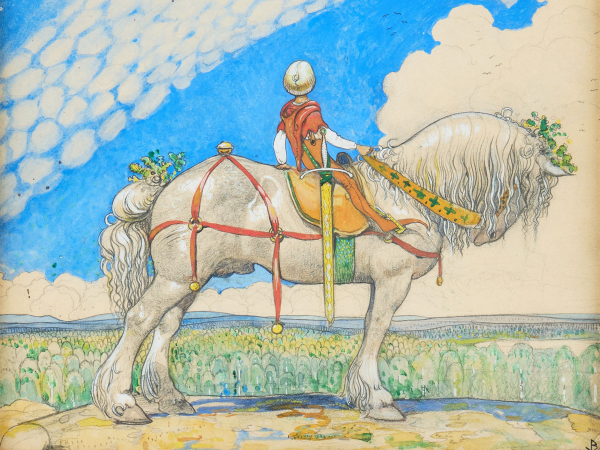
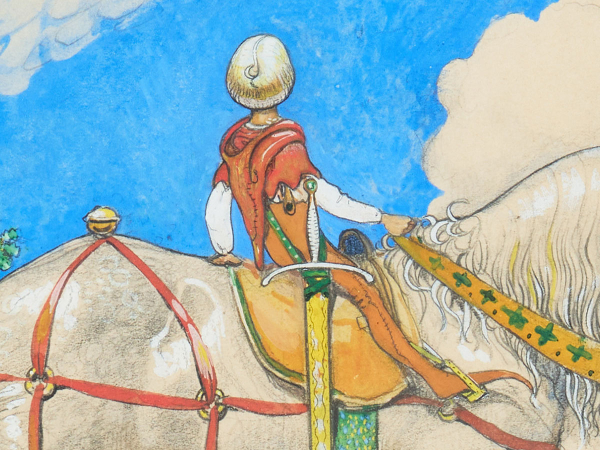
The watercolour contains several details that reveal Bauer’s strong impressions from his travels across Europe. His German heritage and journeys through Germany can be seen in the boy’s medieval clothing — the hood and pointed shoes, or poulaines. The patterns on the horse’s bridle and sword sheath likewise echo a bygone age. The red ribbons with golden details adorning the horse perhaps evoke thoughts of a straw Yule goat with its red ribbons, or a wrapped gift of some kind. Beyond this, however, there is little in the image that directly evokes Christmas.
At the beginning of his collaboration with John Bauer, the publisher Erik Åkerlund stipulated that he would retain the original works, resulting in an extensive collection of more than forty watercolours and paintings. When Åkerlund began building Villa Lyngsåsa on Dalarö in the 1920s, he commissioned Gustaf Magnusson to create a large fresco copy of “Ut i vida världen” in the entrance hall, which was later recreated in his home in Diplomatstaden.
The present work may be interpreted as an image of growing up. To venture “out into the wide world” is not only about a physical journey, but also about inner development. In December 1906, John Bauer married Ester Ellqvist after a relationship that began during their studies at the Royal Academy of Fine Arts. The new situation they both faced may well have resembled the feeling of standing at the edge of the unknown. The years preceding their marriage had, for Bauer, been marked by anxiety and self-doubt over his ability to support them both, and their correspondence reveals an artist struggling with uncertainty and deep melancholy — what Bauer’s biographer Harald Schiller described as the dark periods of his life. Yet, as “Ut i vida världen” suggests, it is towards the unknown — towards what lies ahead, towards the light — that we must strive. Following his marriage to Ellqvist, Bauer would go on to transform Swedish art history, and it is still his fairy-tale world to which we gladly escape today. Through his unique style and his profound sense for the magic of storytelling, John Bauer succeeded in creating an image that continues to move and inspire.
John Bauer (Sweden 1882–1918) “Ut i vida världen” (“Out into the Wide World”)
Watercolour, ink, bodycolour and pencil on paper, 36 x 29 cm; including frame 60 x 50 cm. Signed JB. Executed in 1907. Inscribed by the artist: “drawn in May 1907 John Bauer”.
Provenance
Erik Åkerlund (1877–1940), Stockholm, founder of Åhlén & Åkerlund, publisher of, among others, Bland Tomtar och Troll. Maja Sjöberg (1906–1934), née Åkerlund. Thereafter by descent to her son Rune Åkerlund. Private collection, Sweden.
Exhibited
Swedish Art Exhibition in Hamburg, Lübeck and Berlin, 1926, cat. no. 26. Royal Swedish Academy of Fine Arts, “John Bauer – Memorial Exhibition”, 1934, cat. no. 65. Prins Eugens Waldemarsudde, Stockholm, “Trollbunden – John Bauer och den magiska naturen” (“Spellbound – John Bauer and the Magical Nature”), 5 September 2020–23 May 2021, cat. no. 18.
Literature
First published as a plate in “Julbocken 1907”. Harald Schiller, “John Bauer Sagotecknaren”, 1935, illustrated in full-page colour, p. 97. Karin Sidén and Carina Rech (eds.), Trollbunden – John Bauer och den magiska naturen, 2020, illustrated p. 3 and listed under cat. no. 18.
Estimate
SEK 2,500,000–3,000,000
Viewing: May 29–June 8, Nybrogatan 32, Stockholm
Live auction: June 10
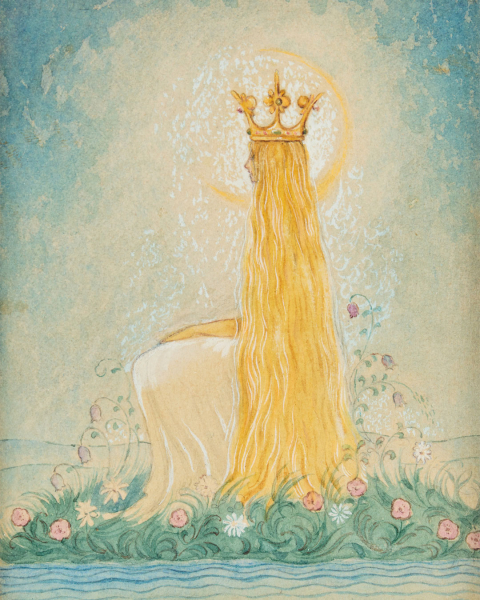
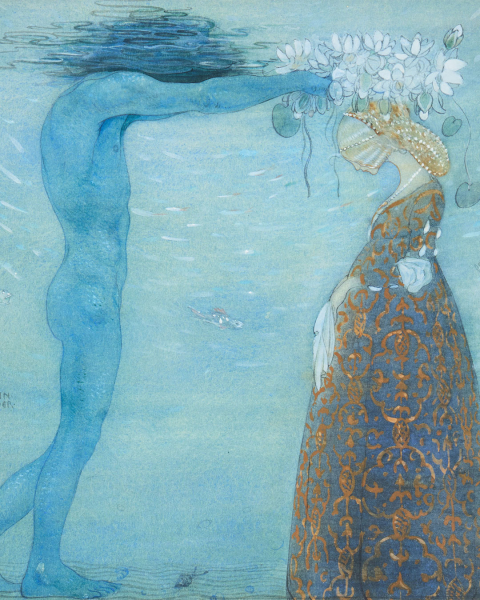
More works by John Bauer at The Curated Classics Sale
Enquiries & condition reports


Currently
More on us