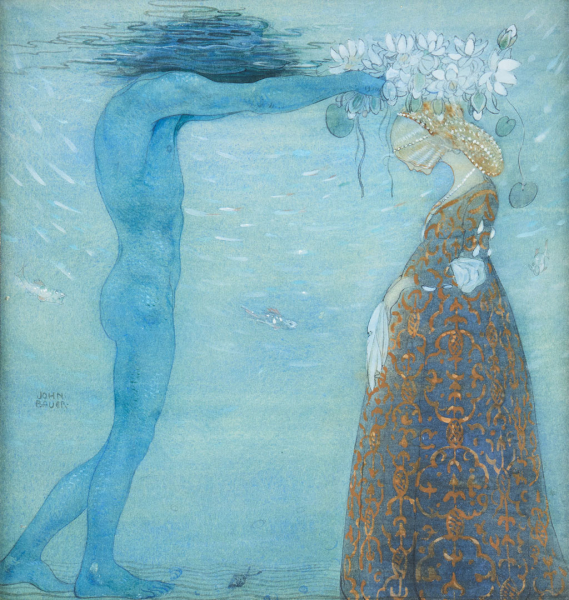
”Sjökungens drottning” by John Bauer
The story of Agneta and the Sea King is a fairy tale about the encounter between humankind and a supernatural being of nature, where love is marked by both beauty and melancholy. It was published in Bland Tomtar och Troll in 1910, compiled by Helena Nyblom. In the tale, Agneta lives a sheltered life at a castle beside a lake, but one evening everything changes when the Sea King appears at the water’s edge. Through cunning, he persuades her to stretch out her hand, and in the next instant she is drawn beneath the surface into his underwater realm.
At first she is overcome with fear, but once she reaches the bottom of the lake, it disappears. In this new world, the Sea King reveals himself in all his splendour, as though his true beauty only becomes visible within his rightful element. Agneta discovers that the world beneath the surface is both enchanting and strange, and soon she is bound to him through both love and wonder. He adorns her with a garland of flowers and plays upon his harp, and through the music she gradually loses memory of her former life. She becomes his bride, and together they live in a dreamlike existence.
In the depictions of the pair, they often appear as a harmonious couple, mirroring one another in profound unity. Yet this enchantment is eventually broken. After bearing several children, Agneta one day hears the sound of church bells — a reminder of her human origins. The memory of her childhood suddenly returns, like awakening from a dream. The Sea King agrees to take her back to land, on the condition that she return before evening. But when Agneta once more sees her father and the world to which she once belonged, she chooses to remain. She breaks her promise and leaves the Sea King behind in solitude together with their children. In the final scene, a clear contrast emerges: Agneta has returned to human society, while the Sea King remains outside it, alien and powerless. The tale may be interpreted as a story about boundaries — between nature and culture, between safety and the unknown. It contains both a warning against leaving the familiar behind and a portrayal of longing for something beyond what is given. At the same time, the narrative is imbued with strong visual and emotional expression: Agneta is portrayed as an idealised figure, while the Sea King represents freedom and elemental power. Throughout the story, the movement of music and water runs like a symbol of their intense yet fragile bond.
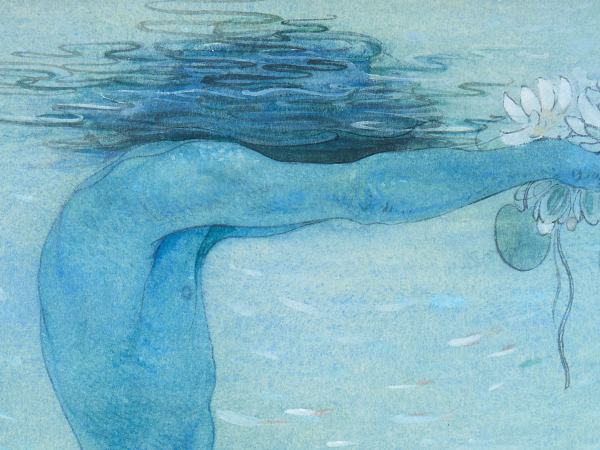
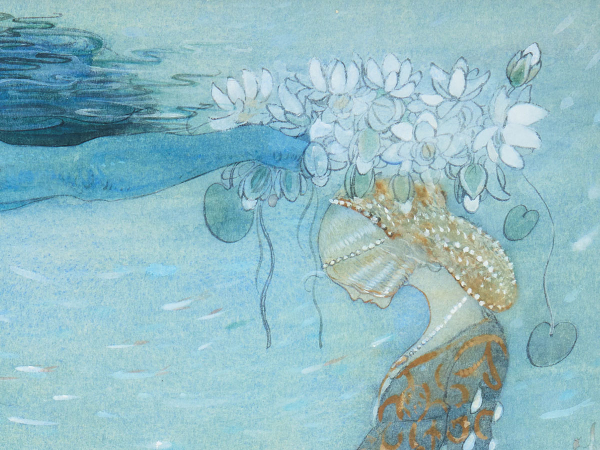
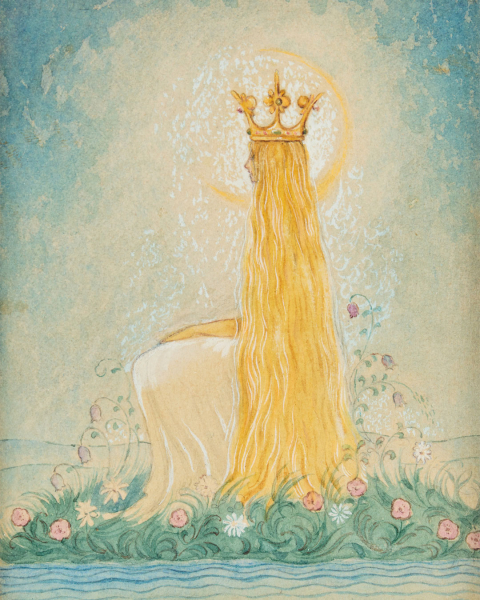
The illustrations accompanying the tale begin with a work in which Bauer may almost be said to have been inspired by the more naïve painting style of Ernst Josephson, before the subsequent images move towards his more recognisable style. In the present work, the Sea King crowns Agneta with a crown of water lilies:
“Now you shall become my queen and live here with me forever. — Do you wish it, little Agneta? Yes, yes! she cried, stretching out her arms. Then the Sea King bound a wreath of great white water lilies and placed it upon Agneta’s hair, and from that moment she was the Sea King’s queen.”
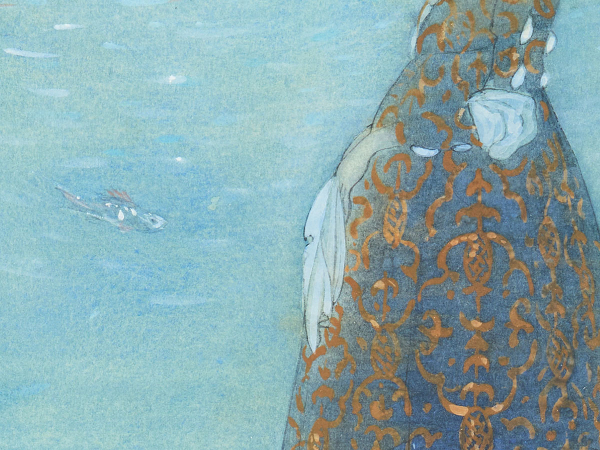
Agneta’s attire and her depiction in profile bear strong influences from the Renaissance painting that Bauer encountered and fell in love with during his time in Italy. In his book on the artist, Harald Schiller writes:
“Whether, as Agneta in Helena Nyblom’s tale ‘Agneta och sjökungen’, she has short hair covered by a small Renaissance hood, or flowing long hair like Alvsol in Ester Edqvist’s ‘Svartjätten och den heliga ljusstaken’, she is a late-born relative of Ghirlandaio’s and Botticelli’s fair-haired and delicate maidens… Yet it is not only the fairy-tale princess who has acquired a Renaissance character — whether she prays by flaming candlelight in a church or speaks with the Sea King at the bottom of the sea — the fairy-tale prince too has become a Florentine youth, parallel in style and form to the princess. Even when Bauer gives them Old Norse costumes, jewellery, and weapons, he allows them to remain children of the Early Renaissance. Thus Bauer’s fairy-tale world found the figures that would henceforth come to dominate it.”
John Bauer (Sweden 1882–1918) “Sjökungens drottning” (“The Sea King’s Queen”)
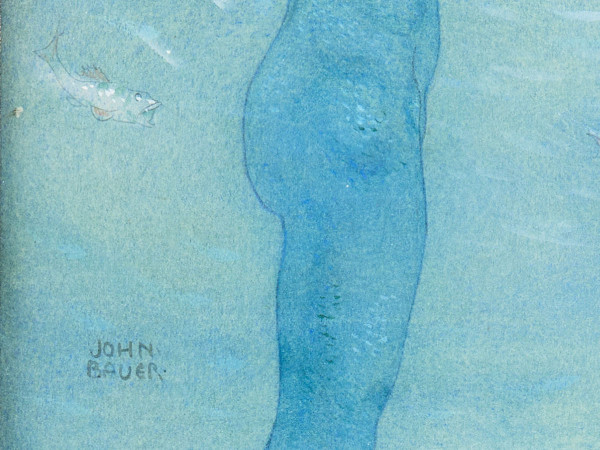
Watercolour, ink and bodycolour on paper, 32.5 x 32 cm. Signed John Bauer. Executed 1909–1910.
Provenance
Miss Yrsa Burmeister, Solna. Private collection, Sweden.
Exhibited
Cirkeln, Stockholm, “John Bauer Memorial Exhibition”, 1919, cat. no. 1. Royal Swedish Academy of Fine Arts, “John Bauer – Memorial Exhibition”, 1934, cat. no. 152, listed as a replica of the illustration for the same tale. Prins Eugens Waldemarsudde, Stockholm, “Trollbunden – John Bauer och den magiska naturen” (“Spellbound – John Bauer and the Magical Nature”), 5 September 2020–23 May 2021, cat. no. 27.
Literature
Illustration for Helena Nyblom’s tale “Agneta och Sjökungen” from Bland Tomtar och Troll, 1910. In the printed book, a different version of the illustration for Agneta’s coronation was used. Harald Schiller, “John Bauer Sagotecknaren”, 1935, illustrated full-page in colour, p. 136 and discussed in the text on p. 136. Karin Sidén and Carina Rech (eds.), Trollbunden – John Bauer och den magiska naturen, 2020, illustrated p. 276 and listed under cat. no. 27.
Estimate
SEK 800,000–1,000,000
Viewing: May 29–June 8, Nybrogatan 32, Stockholm
Live auction: June 10
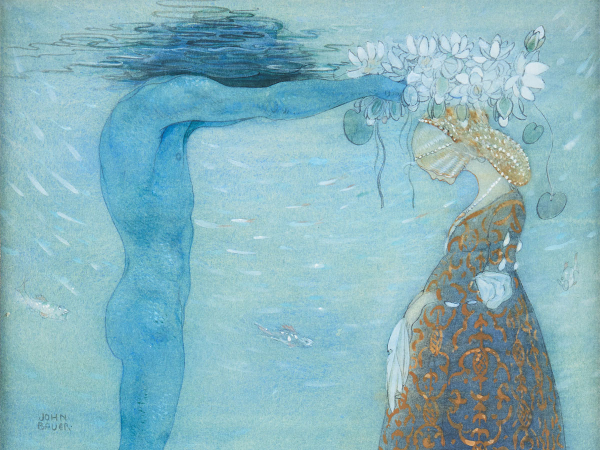
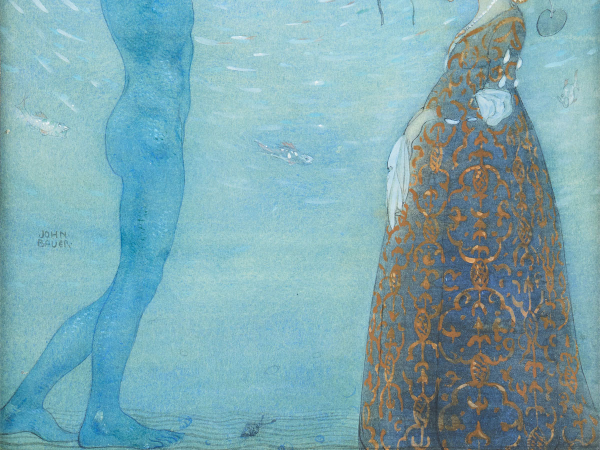
More works by John Bauer at The Curated Classics Sale
Enquiries & condition reports



Ajankohtaista

Lisätietoja meistä