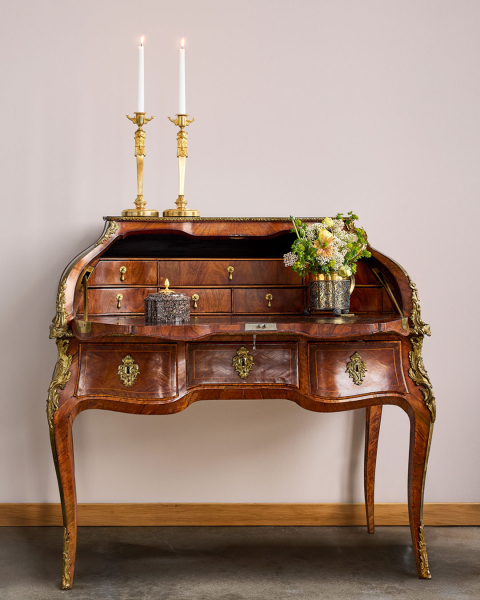
A high-quality secrétaire by Nils Dahlin
Nils Dahlin became a master of the Stockholm Cabinetmakers’ Guild in 1761, presenting as his masterpiece a cabinet in the conventional Rococo style. Until recently, little was known about his training, but it is now established that he apprenticed in Malmö, where he became a journeyman under Olof Iwersson, alderman of the cabinetmakers’ guild. At this time, the Malmö guild was likely among the finest in the kingdom in terms of craftsmanship. Significantly, Olof Iwersson’s two sons, Gottlieb and Fredrik, later moved to Stockholm and worked there as journeymen under Nils Dahlin himself. Gottlieb Iwersson would eventually become the most celebrated cabinetmaker of the Gustavian and Late Gustavian periods after Georg Haupt.
When an apprentice attained journeyman status, it was customary in earlier times in many trades — cabinetmaking among them — to complete one’s education abroad. No archival evidence concerning Dahlin’s journeyman travels has yet been discovered. However, as Dahlin became one of the most French-influenced cabinetmakers of Stockholm’s Rococo period, it seems almost certain that he must have spent a considerable part of his journeyman years in Paris. The absence of documentary evidence is nevertheless compensated by surviving material. In the 1970s, a small and exceedingly elegant lady’s secrétaire — unmistakably Parisian in workmanship and bearing his signature, almost certainly inscribed during his journeyman years — was sold at auction in Zurich. Equally French and un-Swedish in character is a lacquered case for a longcase clock with chinoiserie decoration, privately owned in Stockholm and signed by Dahlin during the 1760s.
There is also compelling evidence that Dahlin, like Haupt a decade later, completed part of his training in London. A small circular tilt-top table entirely in mahogany, of the distinctly English “piecrust” type with raised scalloped edge, signed “N. DAHLIN” and acquired by the Nordic Museum some years ago, clearly points to his stay in London. He later produced large serving platters in the same technique for the public celebrations surrounding the coronation of Gustav III, from which the public was served substantial roasts. Traces of his English training can also be seen in details of his otherwise Parisian-inspired commodes. He frequently fitted them with a so-called cockbead — a thin moulding applied around drawer edges to prevent, for example, an upright lock pin from damaging the veneer. Brass-mounted cockbeads later became common on drawers in Swedish mahogany furniture of the Late Gustavian period.
Stockholm had many highly skilled cabinetmakers during the Rococo era, but Nils Dahlin must surely rank among the foremost when considering both the technical and artistic excellence of his work, which fully withstands comparison with the finest Parisian cabinetmaking. He was also one of the few Stockholm cabinetmakers who successfully navigated the transition from Rococo to the Gustavian style, and the furniture from his later period is in no way inferior to his earlier production in either elegance or quality. In the collections of the Nordic Museum there is a restrained Gustavian card table, decorated internally with exquisite marquetry of flowers and musical instruments in the Parisian Rococo manner, skilfully offsetting the otherwise austere neoclassical form of the table.
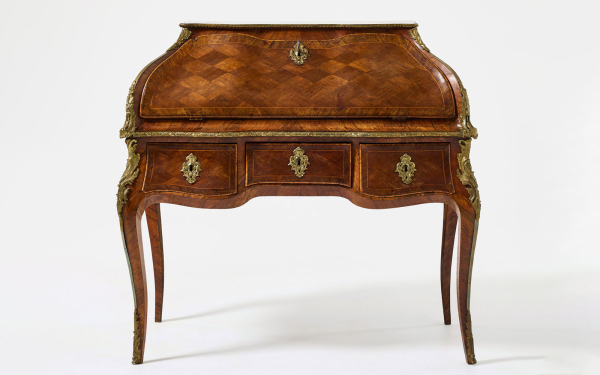
His greatest contribution to the art of furniture-making, however, belongs to the Rococo period, and among these works his secrétaires undoubtedly occupy the foremost place. Several examples are known, varying slightly in size and in the details of their marquetry decoration. These secrétaires are unquestionably among the most graceful pieces of furniture produced during the Swedish Rococo period. With relatively modest means — such as the chamfered aprons — Dahlin succeeded in giving the secrétaire a lighter and more refined appearance that greatly enhances the harmony of the piece.
Dahlin’s known oeuvre today is exceedingly limited, amounting to little more than a dozen surviving pieces of furniture. The reason for this remains unclear, though it may partly be explained by his extensive interior commissions, including work for the Royal Palace in Stockholm, Drottningholm Palace, Adolf Fredrik Church, and Stockholm Cathedral.
The most exclusive of his secrétaires, decorated with lacquer panels mounted over veneered surfaces, was sold in spring 2008 at Uppsala Auktionskammare and became the most expensive antique piece of furniture ever sold in Sweden. The secrétaire offered in the present sale is directly related in form, though entirely clad in exotic veneers rather than lacquer panels.
45. Nils Dahlin (master cabinetmaker in Stockholm 1761-1787), bureau, high-quality Stockholm Rococo work, the back signed six times with the stamped mark N.DAHLIN, veneered with amaranth, rosewood and interior in walnut, bronze and brass mounts.
Estimate: 250 000–300 000 SEK
The Curated Classics Sale
Viewing: May 29–June 8, Nybrogatan 32, Stockholm
Live auction: June 9–10
Contact

Currently
More on us