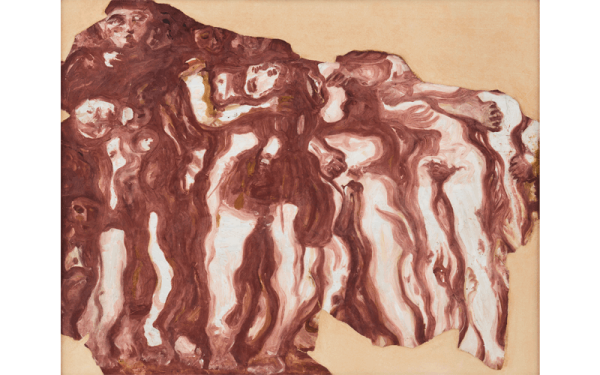
Carl Fredrik Hill, ”Skräck”
The present work, “Skräck” (“Terror”) – also referred to as “Figurer som omfamnar varandra” (“Figures Embracing Each Other”) – occupies a singular position within the oeuvre of Carl Fredrik Hill. Executed during the early years of the so-called illness period in the 1880s, the painting bears witness to a decisive shift from naturalistic landscape painting towards a more visionary and psychologically charged visual language.
During the 1870s, Hill had established himself in France as one of the most gifted landscape painters of his generation. In 1878, however, he suffered a severe psychological crisis that led to his admission to a psychiatric institution. Following his return to Lund, he spent the remainder of his life under the care of his family. It was within this state of isolation that a new artistic world emerged — one shaped by inner visions, symbolism, and existential intensity.
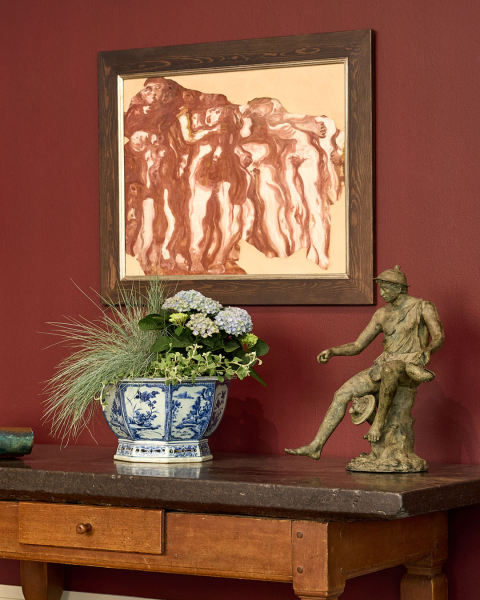
“Skräck” stands out as an unusual example within this body of work, not least because of its medium: an oil painting rather than the more frequently occurring drawings. The motif — two figures locked in a close, almost desperate embrace — carries a powerful emotional charge. Here, an existential anxiety in the face of the incomprehensible is expressed, while colour assumes a central, almost autonomous role in conveying emotional states rather than external reality. The composition is closed and intense, lacking clear references to the outside world, thereby reinforcing the impression of an inner scene, a psychological landscape.
The catalogue work has been exhibited at the Munch Museum, and strong affinities may be observed between the artistic worlds of Carl Fredrik Hill and Edvard Munch, both of whom, in their own ways, dissolve their motifs and place them within a deeply spiritual and psychological context.
The painting has no direct counterpart within Hill’s other works from the illness years, which he himself described as created “behind a poor prison-house door”. This very isolation may contribute to the work’s distinctive expressive power — a concentration of feeling and form that breaks with the conventions of its time and anticipates a more modern, expressive visual language.
The provenance of the work is unbroken and well documented. It was acquired in 1921 from the artist’s sister, Hedda Hill, in Lund, and has since remained within the same family. Its exhibition history is both extensive and distinguished, with early showings already in 1945 and later acclaimed presentations, notably at the exhibition held at Prins Eugens Waldemarsudde in 2011, where the painting attracted particular attention.
In art historical literature, the work has been discussed by both Nils Lindhagen and Sten Åke Nilsson, further underlining its significance within Hill’s late production. Its appearance in the film Det sköna är svårt (“Beauty Is Difficult”) (1985), directed by Anders Wahlgren, also testifies to its continuing cultural relevance.
Today, Carl Fredrik Hill is regarded as a central figure in Swedish art history — not only for his lyrical French landscapes, but equally for the visionary and deeply personal works created during his illness years. In this context, “Skräck” stands as a key work: an image of human vulnerability, but also of intimacy and dependence, in which the boundary between consolation and despair remains hauntingly unresolved.
522. Carl Fredrik Hill, ”Skräck”
Oil on paper, mounted on cardboard, 62 x 76 cm, including frame 85 x 96 cm. Likely executed around 1886. Also titled “Figurer som omfamnar varandra” (“Figures embracing each other”).
Estimate: 500 000–700 000 SEK
The Curated Classics Sale
Viewing: May 29–June 8, Nybrogatan 32, Stockholm
Live auction: June 9–10
Contact


Currently
More on us