An exceptionally high-quality chest of drawers by Johan Neijber
When Georg Haupt returned to Sweden from his stay in Paris in 1769, he paved the way for the arrival of the Neoclassical style in Stockholm. Until then, the lavish Rococo style had dominated among the city’s cabinetmakers. Haupt instead worked in a contemporary French style that became popular during the reign of King Louis XVI, where straight lines and inlaid decoration featuring classical elements were the height of fashion. His masterpiece upon returning to Stockholm was a writing desk clearly influenced by what he had learned in Paris. The desk, possibly executed with some involvement from the court superintendent Jean Erik Rehn, would in time pave the way for what became Gustavian furniture design, consigning Rococo aesthetics to history. The masterpiece was made for Queen Lovisa Ulrika (1720–1782) and was most likely presented to her as a Christmas gift in 1770 from her husband, King Adolf Fredrik (1710–1771). It remains today in the collections of Drottningholm Palace.
One of those who followed the Neoclassical style established by Haupt was Johan Neijber. To those interested in furniture history, the name Neijber is familiar, as it belonged to a well-established family within Stockholm’s cabinetmaking guild, with several masters active during the 18th century. Johan Neijber learned his trade in the workshop of Johan Åbrandt, who had married into the Neijber family. In 1768, after his masterwork — a Rococo chest of drawers — had been approved by the guild, he became a master with his own workshop. His production of Rococo chests is characterised by superb craftsmanship and a confident, robust sense of form. What is most remarkable about Neijber is his evident skill in adapting to the new stylistic direction. His ability to move so successfully from producing powerful Rococo chests to creating elegant and refined Gustavian pieces with rich marquetry decoration is impressive indeed — a transition that certainly not all Stockholm masters managed with equal success.
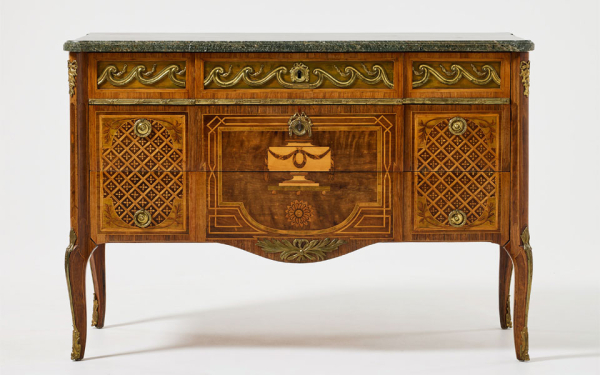
The exceptionally fine chest of drawers offered in this auction, made around 1780, is a typical representative of the successful examples of furniture produced in the spirit of the great master during the so-called “Haupt era”. The quality of the chest, both in form and execution, is of such distinction that it would not look out of place in any interior, not even a royal one. From an art historical perspective, it may perhaps be even more interesting than a piece by Haupt himself, as it was created by a cabinetmaker who proved to be a true pioneer in his ability to embrace the new style so skilfully, despite never having had the opportunity to study at its cradle in Paris. Stylistically, all of Neijber’s marquetry motifs can be found in Georg Haupt’s works: trellis patterns with fleurons, centrally placed urns, fleurons and laurel festoons within fields of intricate friezes. Likewise, the bronze border featuring the running dog motif is a constantly recurring element in Haupt’s chests of drawers. Among Haupt’s works that may serve as reference material for comparative study are a pair of commodes from 1783 with laurel festoons and fleurons; a pair of secretaire cabinets from 1778 with trellis motifs; and a chest of drawers from around 1777 featuring a central urn motif — all in the collections of the Royal Household Treasury.
As can be seen, the chest has been carefully preserved through generations and remains in remarkably good condition, likely the result of having been passed down within the same family since it was made around 1780. We know that the piece formed part of the collections of Baron Adolf Tersmeden, ironworks manager and owner of Ramnäs ironworks in Västmanland. Earlier estate inventories from Tersmeden’s ancestors are rather summary in their descriptions of inherited property; however, his grandmother, the French Countess Marie Stanislas Josefine Sparre (1760–1824), is of particular interest in this context. During her first marriage to Count Fabian Wrede af Elimä, she served as lady-in-waiting to Queen Sofia Magdalena from 1781 and, together with her husband, maintained close ties to the royal family. Following her divorce from Count Wrede in 1796, she remarried in 1801 to Baron Fredrik Tersmeden (1752–1819). Upon her death in 1824, inventories were recorded both for her home in Norrmalm, Stockholm, and for her official residence at Drottningholm, as she had been granted the rank of councillor’s widow in 1817. Under the heading “Furniture and Household Effects at Drottningholm”, the inventory notes “1 Bureau with stone top”, which may possibly refer to the chest in this auction. Both of her residences appear richly furnished, and Carl Fredrik von Breda’s portrait of her father, the French Count Louis Ernest Joseph Sparre, was also inherited within the Tersmeden family (see lot no. 484).
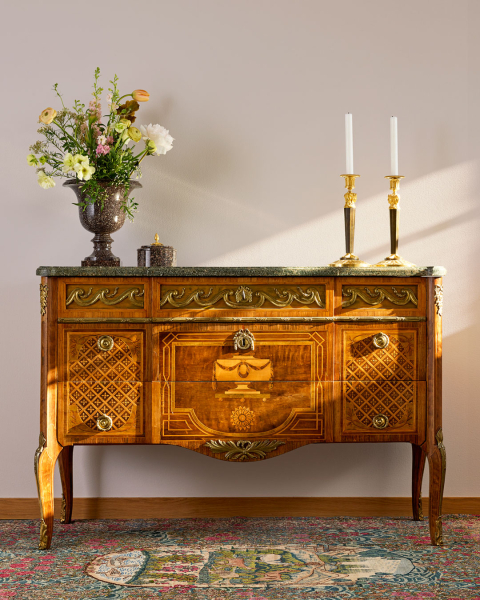
Johan Neijber (master cabinetmaker in Stockholm 1768–1795/1808), chest of drawers, high-quality Gustavian Stockholm work, circa 1780, the top marked in red chalk “Johan Nebert”.
Estimate: SEK 600,000–800,000
The Curated Classics Sale
Viewing: May 29–June 8, Nybrogatan 32, Stockholm
Live auction: June 9–10
Contact

Currently
More on us