Two Rare Allegorical Terracotta Sculptures by Laurent Delvaux
In 1760, under the direction of the architect Jean Faulte (1726–1766), construction began on the new summer quarters of the Brussels palace of the Lorraine prince, Governor of the Netherlands in the service of Austria, Charles Alexander of Lorraine (1712–1780). The entrance to the building, in the form of a concave semicircle, the central part of the structure and the seat of the Governor-General of the Austrian Netherlands, is in a style that foreshadows the Neoclassical architecture of the 1780s and 1800s. With the aim of firmly establishing the power of Governor-General Charles Alexander, the choice of allegorical figures adorning the prestigious façade had to be entrusted to a leading sculptor. The choice fell upon Laurent Delvaux. The sculptor, in consultation with the Governor-General and his architect, proposed to exalt, beyond the person of Charles Alexander, the just, civic, and moral power of the Imperial Crown through the representation of five female allegorical figures: Magnanimity, Bravery, Humanity, Politics, and Religion. They were accompanied by four statues of children symbolizing the cardinal virtues: Justice, Temperance, Fortitude, and Prudence.
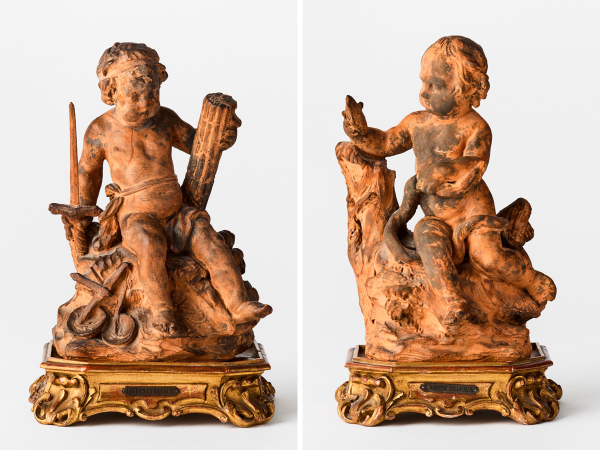
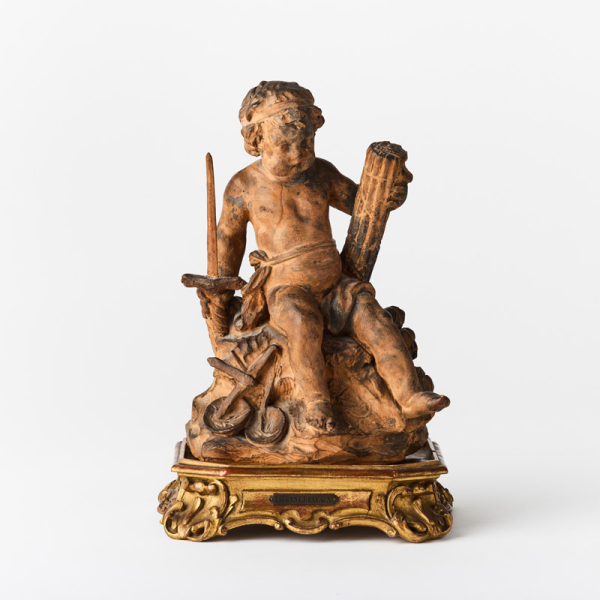
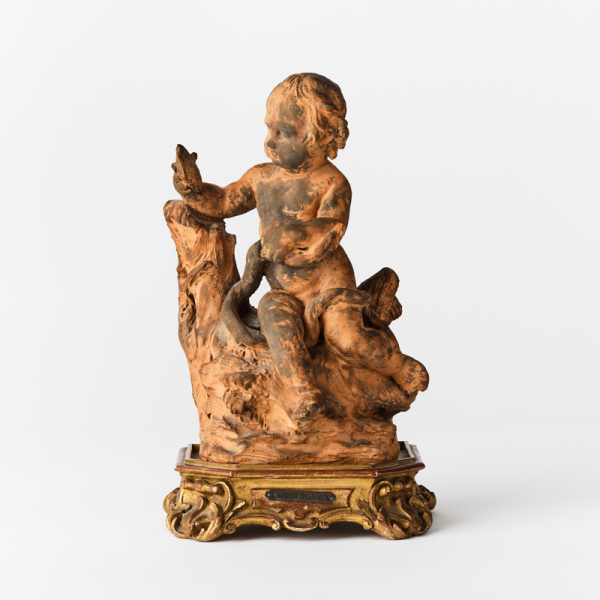
The two works presented here are the rare preparatory sketches modeled in terracotta for the stone figures of Justice and Prudence.
After periods spent in England, Italy, and France, and a career already rich in important commissions, Laurent Delvaux was in the almost exclusive service of the princely patron, Charles Alexander of Lorraine, during the 1760s. This period was undoubtedly the artist’s most brilliant and prestigious. The commission of the cardinal virtues to the great Ghent sculptor in 1760 took place within a context of true peace, prosperity, and the flourishing of the Fine Arts in Brussels.
Modeled with vigor, fluidity, and precision, these two studies are important witnesses to what these now heavily eroded statues once looked like. Perhaps to harmonize the entire façade while breaking with the series of five other allegorical figures, Delvaux substituted the usual female figures of the Cardinal Virtues of the Baroque period with nude children seated on rocks, adorned with attributes that personify them.
Justice holds the Roman fasces and a sword symbolizing authority and power, while at her feet, scales represent impartiality. Accompanied by the emblematic serpent, the putto personifying Prudence holds a mirror in which he gazes at his reflection. It is worth noting that this last attribute no longer appears on the final stone sculpture. All four of Delvaux’s terracotta studies, preparatory to this important architectural project, are documented in the literature on the artist. Temperance is held at the Royal Museums of Fine Arts of Belgium (inv. 10491), while the sketch for Fortitude is in a private collection. Unique on the art market, our two terracotta allegories come directly from the sculptor’s family through inheritance.
Learn more in the catalogue
The Curated Classics Sale
Viewing: May 29–June 8, Nybrogatan 32, Stockholm
Live auction: June 9–10
Contact


Currently
More on us